
Trading Kaise Seekhe: An Easy 7-Step Roadmap for Complete Beginners (2026)
Written by Dinesh Verma, Founder of MonarkFX, Uttam Nagar, New Delhi. Active in Indian, forex and crypto markets since 2021 and mentoring beginners in price action and demand-supply trading.
Disclaimer: This article is for education only and is not investment advice. Trading carries a real risk of losing capital.
“Trading kaise seekhe?” is probably the most common question I get on Instagram. People usually ask it right after losing money on a tip, or right before they’re about to. So let me answer it the way I would if you walked into our Uttam Nagar centre with zero knowledge: in the right order, with real risks, and without any income promises.
Quick Answer: Trading Kaise Seekhe?
Table of Contents
Learn trading in this order: understand how the market works, open a demat and trading account with a SEBI-registered broker, learn chart reading, learn risk management, practise with paper trades for at least six to eight weeks, keep a trade journal, and then start with very small real trades. Most beginners need four to six months before they trade with confidence.
What Trading Is (and What It Isn’t)
Trading means buying and selling shares, futures, options or currencies over a short period, from minutes to a few weeks, to profit from price moves. Investing is different. Investors hold for years and focus on business growth.
Trading is not a quick way to double money, and it is not a replacement for a salary in the first year. It’s a skill, like driving or coding. You get better with practice and feedback, and you make mistakes along the way.
Trading Kaise Seekhe: The 7-Step Roadmap
Step 1: Learn How the Market Works
- What NSE and BSE are, and what SEBI does
- Shares, indices like Nifty and Sensex, F&O basics
- Order types: market, limit, stop loss
- Market timings: 9:15 am to 3:30 pm for equity
Step 2: Open the Right Accounts
Open a demat and trading account with a broker registered with SEBI. You can verify any broker on the SEBI website. Never give your login or OTP to anyone who says they’ll “trade for you”.
Step 3: Learn Chart Reading
- Candlesticks and what they show about buyers and sellers
- Trend and market structure
- Support, resistance and demand-supply zones
- Volume and how it confirms moves
Step 4: Learn Risk Management
- Risk 1% of capital per trade
- Always use a stop loss
- Size positions based on stop loss distance
- Stop trading for the day after a fixed loss
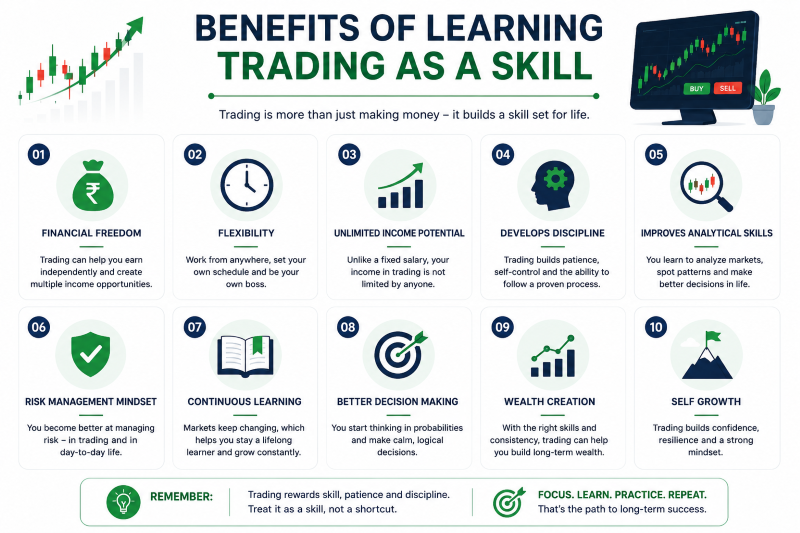
Step 5: Paper Trade for 6 to 8 Weeks
Practise every setup without real money first. Use the same capital and size you would use live. Take at least 40 trades. I explain this process in detail in our guide to demo trading the right way; the same rules apply to stocks.
Step 6: Keep a Trade Journal
Write down every trade: date, stock, entry, stop, target, reason, result and emotion. Review it every weekend. The journal shows you mistakes you can’t see in the moment.
Step 7: Start Small With Real Money
Trade the smallest quantity possible for your first 20 to 30 trades. Your goal is to follow your rules under real pressure, not to make money yet.
Which Trading Style Should a Beginner Pick?
| Style | Holding time | Good for beginners? |
|---|---|---|
| Scalping | Seconds to minutes | No, too fast |
| Intraday | Same day | Only after a few months of practice |
| Swing trading | Days to weeks | Yes, usually the best start |
| Positional | Weeks to months | Yes, for patient people |
Before trying intraday, read is intraday trading safe for beginners.
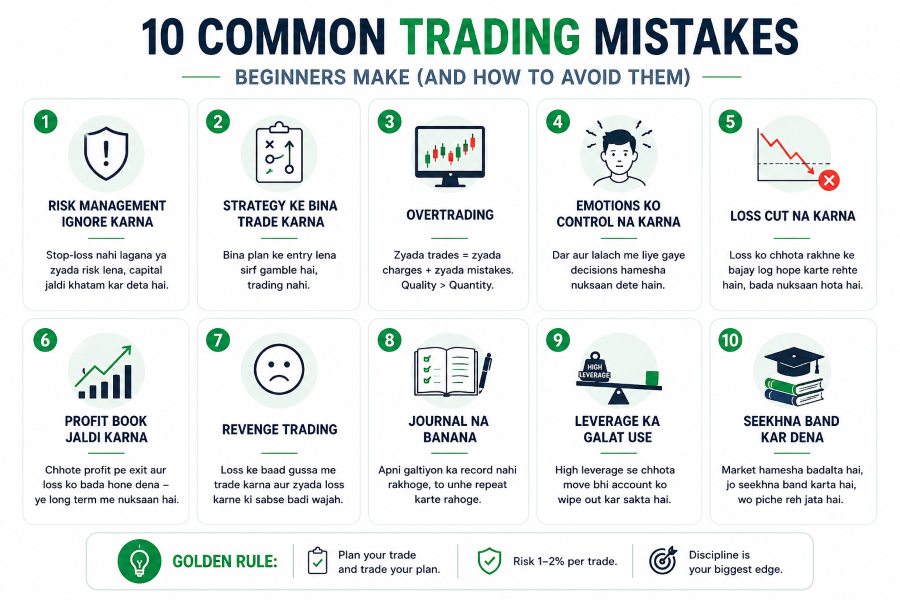
Common Beginner Mistakes
- Starting with options because the capital needed is small.
- Following Telegram tips instead of learning.
- Trading without a stop loss.
- Putting big size on one “sure shot” trade.
- Quitting a method after two losses.
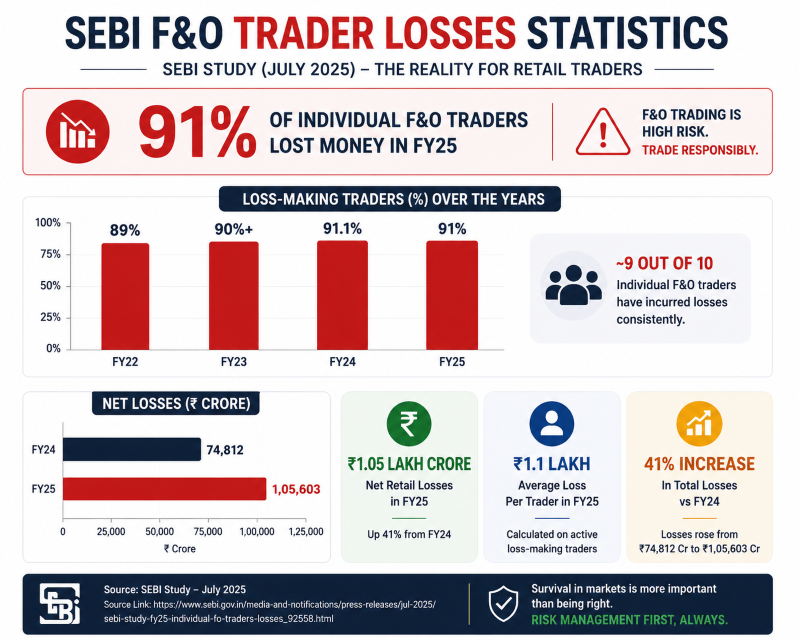
A SEBI study in 2024 found that 93% of individual F&O traders lost money over three years. Most of these mistakes show up again and again in that group.
How Long Does It Take to Learn Trading?
- Month 1 to 2: market basics, charts and risk rules
- Month 2 to 4: paper trading with a journal
- Month 4 to 6: small live trades
- After 6 months: slow increase in size, only if rules hold
Self-Learning or a Course?
You can learn alone with free resources if you’re disciplined. A course helps when you want a fixed order and feedback on your trades. If you choose a course, check our guide on why many trading classes in Delhi fail so you know what to avoid. For a complete beginner guide to the stock market, read how to learn the stock market in India.
If you’re in Delhi, you can also sit in a free demo class at MonarkFX and see how we teach. That’s the simplest answer to “trading kaise seekhe”: watch how it’s taught properly once, then decide your path.
Advanced Concepts We Teach: SMC, ICT and Liquidity
Basic chart reading is only the start. After students are comfortable with it, we add the concepts that explain how large players move the market:
- Support and resistance and demand and supply zones as the base
- Liquidity: equal highs and lows, stop loss clusters and liquidity sweeps
- Smart Money Concepts (SMC): break of structure (BOS), change of character (CHoCH), order blocks and fair value gaps
- ICT ideas: premium and discount areas and session timing
- RSI divergence as confirmation at key zones, never as a standalone signal
All of these are taught on live charts with paper trades, not as theory. See how they fit together in our price action trading course in Delhi.
Frequently Asked Questions
Trading kaise seekhe as a complete beginner?
Learn market basics, open an account with a SEBI-registered broker, study chart reading and risk management, paper trade for six to eight weeks with a journal, and then start with very small real trades.
How much money do I need to start trading?
You can start learning with zero money through paper trading. For live trades, start with an amount you can afford to lose and risk only about 1% per trade.
How many months does it take to learn trading?
Most beginners need four to six months of learning and practice before trading small live positions with confidence.
Which trading is best for beginners?
Swing trading is usually the best start because it needs less screen time and gives more time to think before each decision.
Can I learn trading from YouTube?
You can learn basics from free videos, but you also need a fixed learning order, practice and feedback on your trades to improve.
About the author: Dinesh Verma has traded Indian, forex and crypto markets since 2021 and runs MonarkFX in Uttam Nagar, West Delhi.
3 Comments