
How to Learn Stock Market in India: An Easy 7-Step Guide for Beginners (2026)
Written by Dinesh Verma, Founder of MonarkFX, Uttam Nagar, New Delhi. Active in Indian, forex and crypto markets since 2021 and teaching beginners how markets actually work.
If you’re trying to figure out how to learn stock market basics in India, you’ve probably noticed the problem already: there’s too much information. Ten YouTubers, five apps, three cousins with “sure shot” tips. What’s missing is a clear order.
This guide gives you that order. It covers the difference between investing and trading, what to learn first, the free and trusted resources in India, a realistic timeline, and the mistakes that cost beginners the most. Whether you want to invest for the long term or learn to trade, start here.
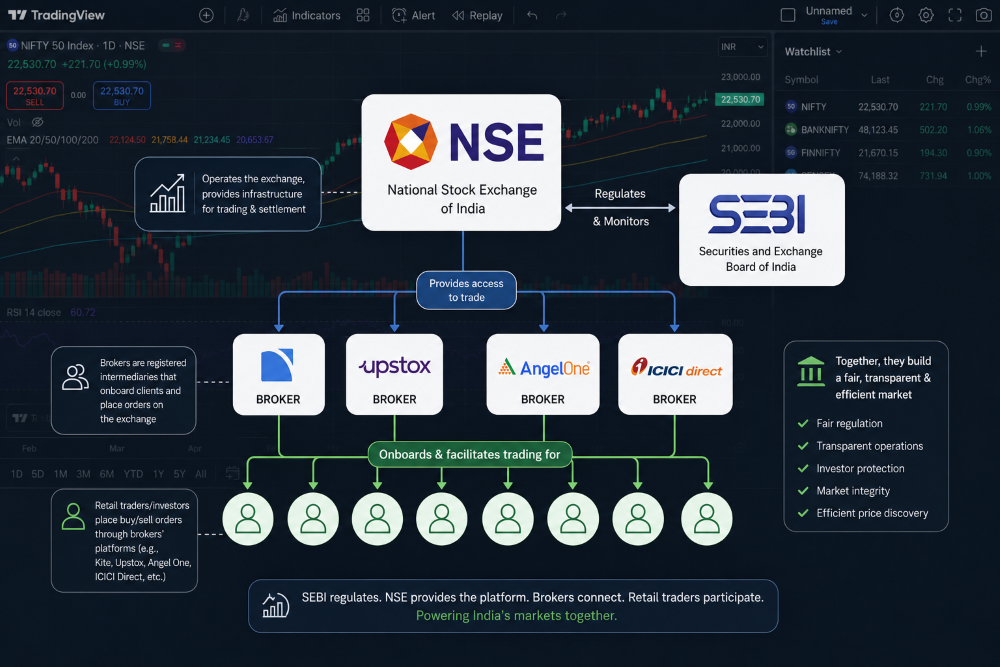
Quick Answer: How to Learn Stock Market in India
Table of Contents
Start by understanding what shares, indices and exchanges are. Decide whether you want to invest, trade or both. Learn basic financial terms, then chart reading and risk management if you plan to trade. Use trusted sources like NSE, BSE and SEBI investor education. Practise with paper trades or very small amounts, keep a journal, and increase only after you see consistent behaviour, not just profits.
Step 1: Understand the Basics
- Shares: a small ownership in a company.
- Stock exchanges: NSE and BSE, where shares are bought and sold.
- SEBI: the regulator that protects investors and registers brokers.
- Indices: Nifty 50 and Sensex track groups of large companies.
- Demat account: holds your shares electronically.
- Trading account: used to place buy and sell orders.
The SEBI investor website explains these basics in simple language and is a good, free first stop.
Step 2: Investing or Trading? Decide Early
| Point | Investing | Trading |
|---|---|---|
| Time frame | Years | Minutes to weeks |
| Focus | Business quality and growth | Price movement and timing |
| Time needed | A few hours a month | Daily screen time |
| Risk | Lower if diversified and long term | Higher, especially with F&O |
| Skills | Reading financials, valuation | Chart reading, risk management |
Many people do both: long-term investing for wealth and a small amount of trading as a skill. Just keep the two separate in your mind and in your accounts.
Step 3: Learn Key Terms
Before placing any order, be comfortable with: market order, limit order, stop loss, bid and ask, volume, market cap, P/E ratio, dividend, F&O, lot size and margin. If a term in a news article confuses you, look it up and write it down. Your own glossary will grow fast.
Step 4: Learn Chart Reading (For Traders)
- Candlesticks and what they show
- Trend: higher highs and higher lows, or the opposite
- Support and resistance
- Demand and supply zones
- Volume confirmation
When people ask me how to learn stock market charts, I say keep it simple. Two clean charts teach more than one chart with seven indicators.

Step 5: Learn Risk Management
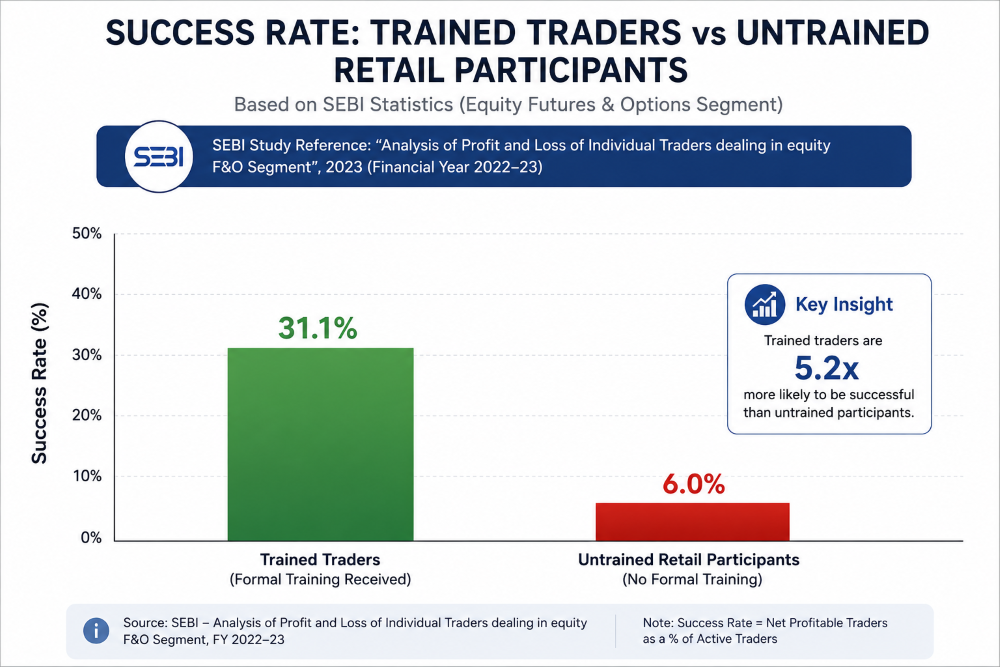
This is the step most people skip, and it is the reason most lose. A SEBI study in 2024 found that 93% of individual F&O traders lost money between FY22 and FY24. If you remember only one thing about how to learn stock market trading, remember this: control the loss first.
- Risk only 1% to 2% of your capital per trade.
- Always decide your stop loss before you enter.
- Don’t put more than 5% to 10% of your portfolio in one stock as a beginner investor.
- Avoid borrowed money for trading.
Step 6: Practise Before Using Real Money
Paper trade for six to eight weeks, or invest very small amounts. Track every decision in a journal with the reason. The aim isn’t profit; it’s learning how you behave when prices move against you.
Step 7: Start Small and Review Weekly
Start with the smallest quantity possible. Every weekend, look at your journal and ask: Did I follow my plan? Where did I break rules? What will I change next week? This weekly habit is the most underrated part of how to learn stock market skills. It separates people who improve from people who repeat mistakes.
Trusted Free Resources in India
- SEBI investor education for basics and investor protection
- NSE and BSE websites for market timings, contract specs and company data
- Company annual reports for investors who want to study businesses
- TradingView for free charts and practice
How Long Does It Take to Learn the Stock Market?
| Goal | Realistic time |
|---|---|
| Understand basics and open accounts | 2 to 4 weeks |
| Start long-term investing in index funds or quality stocks | 1 to 2 months |
| Learn to trade with charts and risk rules | 4 to 6 months |
| Become consistent as a trader | 1 year or more |
Mistakes Beginners Make
- Buying on tips without knowing the company.
- Jumping into options in the first month.
- No stop loss, or moving it further away.
- Checking the portfolio every 10 minutes and panicking.
- Learning from too many sources at once.
Should You Join a Stock Market Course?
You can learn a lot alone. A course helps if you want a fixed order, live practice and someone to review your trades. If you’re in Delhi, compare options using our guide to the best stock market institute in Delhi, and read why many trading classes fail so you know what to avoid. For course details, see stock market classes in Delhi.
If you prefer a short Hinglish-friendly roadmap focused only on trading, read trading kaise seekhe. And before trying intraday, read is intraday trading safe for beginners.
Advanced Concepts We Teach: SMC, ICT and Liquidity
Basic chart reading is only the start. After students are comfortable with it, we add the concepts that explain how large players move the market:
- Support and resistance and demand and supply zones as the base
- Liquidity: equal highs and lows, stop loss clusters and liquidity sweeps
- Smart Money Concepts (SMC): break of structure (BOS), change of character (CHoCH), order blocks and fair value gaps
- ICT ideas: premium and discount areas and session timing
- RSI divergence as confirmation at key zones, never as a standalone signal
All of these are taught on live charts with paper trades, not as theory. See how they fit together in our price action trading course in Delhi.
Frequently Asked Questions
How to learn stock market from zero in India?
Start with basics like shares, exchanges, SEBI and demat accounts. Decide between investing and trading, learn key terms, then chart reading and risk management for trading. Practise with paper trades or small amounts and review a journal weekly.
Can I learn the stock market by myself?
Yes. Many people learn from SEBI and exchange resources, books, charts and practice. A course helps if you want structure and feedback.
How much money do I need to start in the stock market?
You can start investing with a few hundred rupees in index funds or a single share. For trading, start with an amount you can afford to lose and risk only 1% to 2% per trade.
How long does it take to learn the stock market?
Basics take a few weeks. Learning to trade with charts and risk rules usually takes four to six months, and becoming consistent can take a year or more.
Is the stock market risky for beginners?
Yes, especially trading and F&O. Beginners can reduce risk by learning first, diversifying investments, using stop losses and avoiding tips.
About the author: Dinesh Verma has traded Indian, forex and crypto markets since 2021 and runs MonarkFX in Uttam Nagar, West Delhi. You can join a free demo class to see how he teaches.
Для доступа к балансу, бонусам и истории ставок не требуется искать обходные пути: вход в личный кабинет 1win доступен с любого устройства, главное — ввести корректные данные своей учётной записи.