
Why Most Trading Classes in Delhi Fail to Create Consistent Traders
Monark FX Team | Stock Market Educator & Trader with Expertise in Demand & Supply Trading, Risk Management, Market Structure Study, and Live Market Training | Our sessions include regular discussions and training in live markets regarding risk management and market structure with emphasis on execution-based education | Published: June 2026 | Last Updated: June 2026
Key Takeaways
- Most trading institutes focus heavily on theory and setup generation, completely ignoring the psychological and risk management aspects of trading.
- Success in the markets requires live execution practice, not just historical chart reading.
- A major reason why most trading classes in Delhi fail to create consistent traders is the lack of post-market analysis and personalized mentoring.
- Mastering trading requires treating it as a performance discipline where tracking data via a trading journal is non-negotiable.
- Institutes must shift from “guaranteed strategy” marketing to execution-based education to build real, lasting competence.
The reason for failure of many trading courses in Delhi in generating good traders is because of the difference between theoretical study and live market execution. Many organizations teach students about fundamental chart patterns and lagging indicators without educating them about market structure and risk management. We found out in our training in Delhi inside the trading room that traders who could concentrate only on making trades found it hard to survive, whereas the traders who focused on risk management and maintained a trading journal performed excellently well. Traders need practical education in live markets rather than theoretical stock market courses.
Comparison: Traditional Trading Classes vs. Execution-Based Learning
| Feature | Traditional Stock Market Institute Delhi | Monark FX Execution-Based Learning |
| Core Focus | Memorizing candlestick patterns & indicators. | Demand & supply, market structure, and risk. |
| Market Exposure | Backtesting on static/historical charts. | Live market training and real-time execution. |
| Psychology | Seldom discussed; focus is only on “winning”. | High emphasis on mindset and emotion control. |
| Student Routine | Listening to lectures and taking notes. | Maintaining a trading journal and risk tracking. |
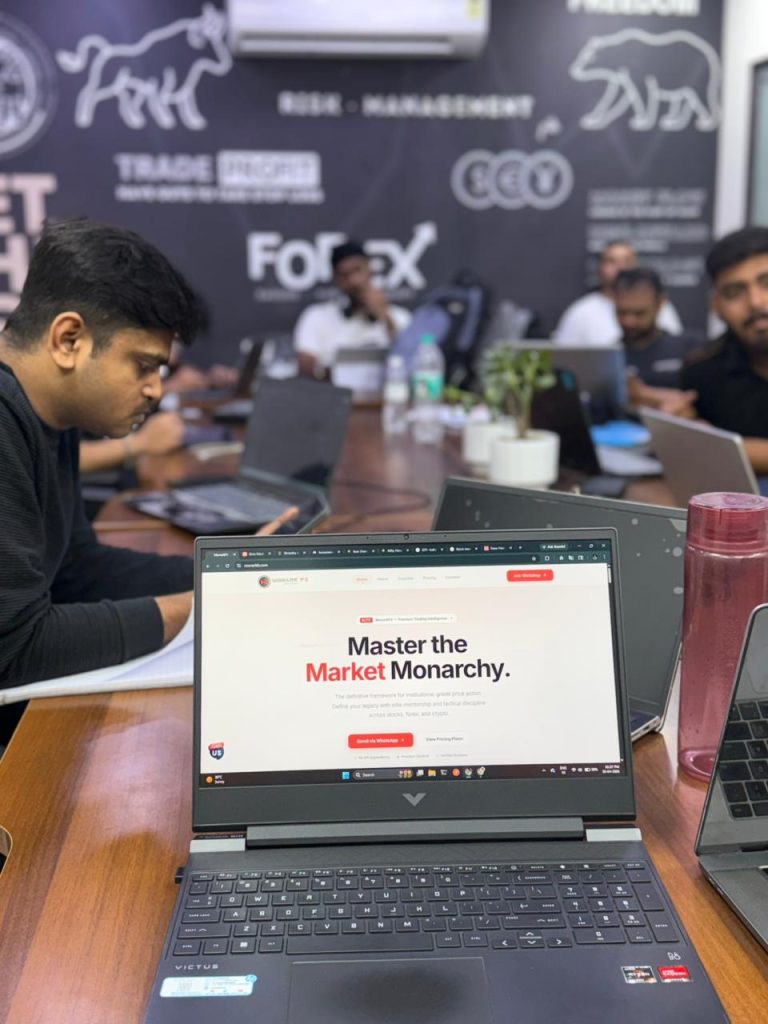
Table of Contents
- What is the Reality of Trading Classes in Delhi?
- How It Works: The Journey from a Beginner to a Consistent Trader
- Key Facts & Data (June 2026)
- Benefits of a Practical Trading Course in Delhi
- Common Mistakes Institutes Make (And Why Students Fail)
- Real-World Example: The Power of Risk Management & Journaling
- Latest Updates & Trends in Market Education — 2026
- Future Outlook for Trading Academies
- People Also Ask
- FAQ
- Conclusion
What is the Reality of Trading Classes in Delhi?
However, the brutal truth about the trading education industry is that theory never equals consistency in practice. Most institutes are more like theoretical colleges than professional trading desks.
The basic things like working of the NSE, BSE, opening a Demat account, and understanding of the concept of the moving average are taught by them. However, knowing the rules of chess won’t make you a grandmaster in playing the game. The trading business is all about probability, psychology, and risks involved in the process. A normal Share Market Training Delhi program will train you about how to enter in the market and when to invest money but does not provide any knowledge regarding management of the investment and handling of psychological issues arising out of losing trades.
How It Works: The Journey from a Beginner to a Consistent Trader
Shifting from a hobbyist to a professional demands a well-laid-out process that most conventional Stock Market Classes in Delhi neglect. Below is the actual process that works:
Market Structure Knowledge: Not only learning basic chart patterns but knowing how institutional money moves the markets through demand and supply zones.
Platform Proficiency: Being competent enough to place trades fast using trading platforms such as Zerodha and Upstox, or even Tradingview for analysis.
Risk Strategy: Knowing your maximum loss per day, position sizes, and risk/reward ratio before making any trade.
Live Markets Execution: Doing the trade live and learning that sahi entry (correct entry) is just 10% of the deal.
Journaling and Reflection: Keeping track of every trade you do, the emotions involved, and the results obtained.
Key Facts & Data (June 2026)
In order to analyze the problem with trading education, we need to have hard facts about the percentage of successful retail traders.
The Truth About Retail Traders: Household Savings through Indian Securities Market
The Price of Bad Education: https://www.dezerv.in/blog/fno-trading-india/
The Effectiveness of Mentorship: The increase in trader retention/profitability while being involved in a live trading room compared to self-study – Financial education peer-reviewed paper 2025.
Platform Supremacy: Zerodha and Upstox still trade the vast majority of retail daily volume, which means that platform knowledge becomes an inevitable part of education. : The combined market share of leading discount brokers – Financial news report, 2026.
The importance of proper education is obvious: without execution-oriented education, retail traders are simply becoming the source of liquidity for institutional players.
Benefits of a Practical Trading Course in Delhi
Choosing a Trading Academy Delhi that focuses on practical, live-market application transforms how you interact with the markets. Here is why execution-based learning is superior.
H3: Real-Time Emotional Regulation
Trading on historical data creates a false sense of security. A practical course puts you in the live market where real money is moving. You learn to handle the anxiety of a floating loss and the greed of a floating profit, which is the ultimate mindset ka khel (game of mindset).
H3: Dynamic Risk Management
Books teach static stop-losses. Live sessions teach you how to trail stops, scale out of positions, and cut losses quickly when the market structure breaks. You learn that capital preservation is far more important than capital appreciation.
H3: Immediate Feedback Loop
If you make a mistake in a theoretical class, you might not find out until you blow your account months later. In a live trading room, mentors can correct your execution errors, poor position sizing, or impulsive trades instantly.
H3: Adapting to Market Context
The market is not a textbook; it changes daily. Practical training teaches you to read the context—whether it’s a trending day, a ranging day, or a highly volatile news-driven day—and adapt your strategy accordingly on platforms like TradingView.
Common Mistakes Institutes Make (And Why Students Fail)
If you are investigating Why Most Trading Classes in Delhi Fail to Create Consistent Traders, look at the systemic flaws in their curriculum.
- Selling “Holy Grail” Strategies: Institutes often market a 90% win-rate strategy. Consequence: Students stop managing risk, believing the strategy is foolproof, which leads to blown accounts when the inevitable losing streak hits.
- Zero Emphasis on Trading Journals: Many classes never teach students how to track their data. Consequence: Traders repeat the same mistakes for years because they have no data to review their performance.
- Teaching in Hindsight: Pointing out a perfect head-and-shoulders pattern on a chart from 2023 is easy. Consequence: Students freeze in the live market because the right edge of the chart is terrifying and uncertain.
- Ignoring the Role of Regulators: Failing to educate students on SEBI guidelines, margin requirements, and the dangers of unregulated forex or crypto platforms. Consequence: Students fall prey to scams or over-leverage their accounts.
Real-World Example: The Power of Risk Management & Journaling
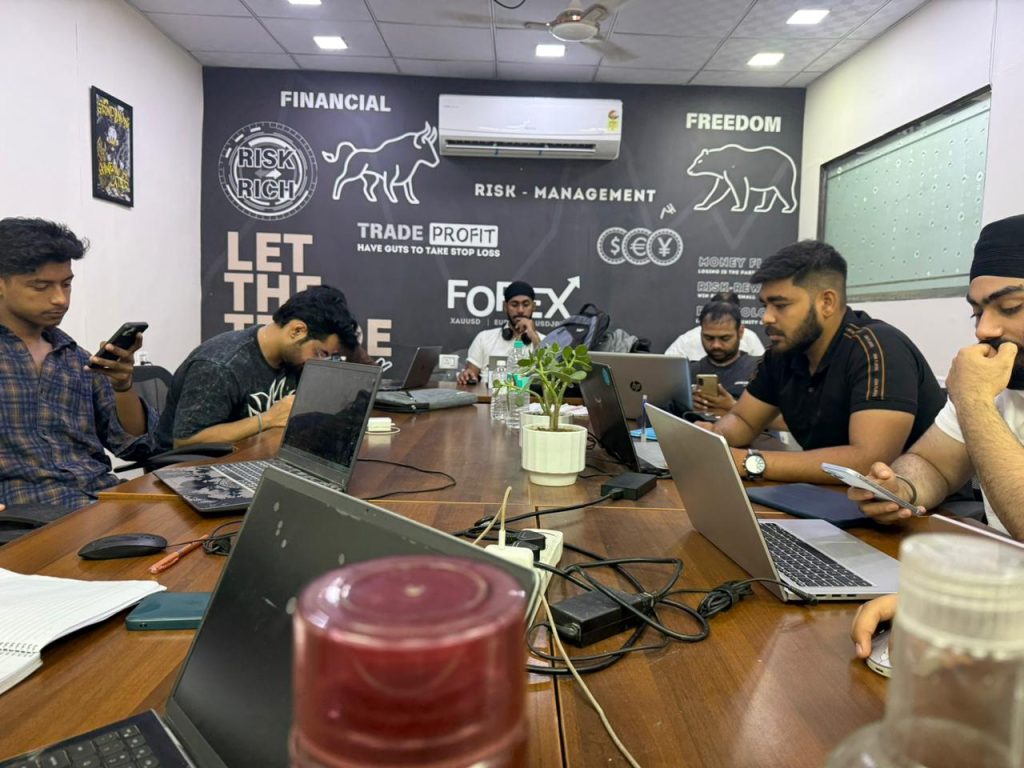
Let’s look at a recurring reality we witness on the floor. At Monark FX, we don’t just teach theory; we trade alongside our students.
During our sessions that took place in Delhi in the trading room, we found that beginners that were only concentrating on placing trades struggled to keep themselves sustained, whereas those traders who managed risks and maintained a trading journal performed well in terms of their results.
We had a bunch of motivated college students and professional people. Group A was totally concerned about having a perfect setup. They used to know every indicator on TradingView and they were totally involved in timing for hitting the buy button. On the contrary, Group B strictly adhered to our rules and followed our execution principle of risk management in the sense that they tried to stick to risking no more than 1% per trade and entered each execution in their journal.
After three months, Group A became frustrated, switching systems, suffering from severe drawdown of their capital. Group B did not win all the trades, but their losses were statistically controlled. After looking at their journal, it was found out that their morning trades brought them profits, while their afternoon trades comprised revenge trades. Group B corrected themselves, did not trade after 11:30 and achieved consistency.
Latest Updates & Trends in Market Education — 2026
The landscape of financial education is shifting rapidly as regulators crack down and technology evolves.
- SEBI‘s Push for Transparency: Regulatory bodies are increasingly scrutinizing “finfluencers” and unregistered advisory services. This has forced the best institutes to pivot from giving “tips” to providing genuine, skill-based education.
- Algorithmic Integration: Modern courses are now incorporating basics of algorithmic thinking, helping discretionary traders understand how institutional bots operate.
- Proprietary Firm Testing: More students are taking courses specifically to pass prop-firm evaluations, shifting the educational focus heavily toward strict drawdown limits and risk management.
Future Outlook for Trading Academies
As we look ahead, the standard for a Stock Market Institute Delhi will change drastically.
- Death of the “Weekend Workshop”: Two-day crash courses will become obsolete as the market realizes that consistency takes months of guided practice, not a 48-hour seminar.
- Simulation to Live Pipelines: Institutes will adopt advanced market replay simulators, requiring students to prove profitability in a simulated environment before they are allowed to touch live capital.
- Psychology-First Curriculums: We will see trading psychologists becoming standard faculty members in trading academies, emphasizing that technical analysis is secondary to emotional discipline.
People Also Ask
Why is it so hard to be a consistent trader? Consistency is difficult because humans are naturally wired to avoid losses and secure quick profits. Trading requires the opposite: cutting losses quickly and letting profits run. It demands extreme emotional control and a statistical mindset, which goes against our natural psychological impulses.
Are trading classes actually worth it? Trading classes are only worth it if they focus on live market execution, risk management, and market structure. If a class only teaches lagging indicators and historical chart patterns without live mentorship, it is likely a waste of time and money.
How long does it take to become a consistently profitable trader? For most individuals, it takes anywhere from 1 to 3 years of dedicated practice, journaling, and live market experience to achieve consistent profitability. It is a profession, much like engineering or medicine, and requires a proportional amount of screen time and study.
Is day trading essentially gambling? Day trading without an edge, a trading plan, and strict risk management is gambling. However, when executed by a trained professional who uses statistical probabilities and strict capital protection rules, it is a disciplined business operation.
FAQ
A: No, you do not need a financial or economic background. Trading is primarily about recognizing visual patterns, understanding probabilities, and managing your own psychology. At Monark FX, we start from the very basics and build up to advanced execution strategies.
A: Investing classes focus on fundamental analysis, reading balance sheets, and holding assets for years. Trading classes focus on technical analysis, price action, and taking advantage of short-term price fluctuations for immediate income.
A: We train our students primarily on industry-standard charting platforms like TradingView, while executing trades on reliable broker platforms like Zerodha or Upstox. Becoming proficient with these tools is a core part of our curriculum.
A: Absolutely. While full-time day trading requires screen presence during market hours, working professionals can learn swing trading or positional trading. These styles require less screen time and focus on higher timeframes, making them ideal for busy schedules.
A: Because without risk management, even a strategy with a 90% win rate will eventually blow your account. Preserving capital is the only way you survive long enough to let your statistical edge play out over a large series of trades.
A: No, we do not provide tips. Our goal is to make you an independent trader capable of reading market structure and executing your own trades confidently. Giving tips creates dependency; teaching execution creates professionals.
Conclusion
Understanding Why Most Trading Classes in Delhi Fail to Create Consistent Traders is the first step toward avoiding the traps of the financial education industry. Consistency isn’t found in a magic indicator or a secret pattern; it is forged through live market execution, unwavering risk management, and rigorous journaling. If you are tired of theoretical lectures and want to learn how to actually trade in the live market, it is time to change your approach.
Join Monark FX Free Demo Class and Experience Practical Market Learning Before Enrolling.
Author Bio
Monark FX Team We are a team of Stock Market Educators & Traders specializing in Demand & Supply Trading, Risk Management, and Market Structure Study. At Monark FX, we help aspiring traders transition from confused beginners to independent professionals through live execution-based education. With hundreds of hours spent mentoring students in live Indian markets, we pride ourselves on building transparent, data-driven traders.