Forex Trading Course Online: 7 Proven Checks to Choose the Best One (2026)
By Dinesh Verma | Founder, MonarkFX. 6+ years of price-action and demand-supply trading, mentoring retail traders across India since 2021. Last updated: October 2026.
Quick answer: A good forex trading course online teaches six things in order: market basics, chart reading, risk management, one clear method, trading psychology and guided demo practice. It gives you live doubt-clearing, support after the course ends, and an honest word on SEBI/RBI rules. If a course squeezes all of this into 2–3 days, skip it.
A while back, a working professional sent me a screenshot of a course syllabus. 45 minutes of “candlestick basics.” 30 minutes of “indicators overview.” Then straight into “advanced strategies.” All of it in a 3-day course priced at ₹15,000.
He asked me if it was worth it. My answer? No. A syllabus that crams months of skill-building into three days isn’t teaching you to trade. It’s teaching you to feel like you learned something. Those are very different things.
That chat is basically why this article exists. I’m not here to rank courses. I want to show you what a real forex trading course online should contain, so you can judge any course (ours included) against an actual standard, not a marketing page.
Table of Contents
If you’re comparing whole institutes rather than single courses, read our guides on how to check a forex trading institute in India and what a genuine forex school online should offer. This piece zooms into the course itself: the syllabus, the structure and the format.
What Should a Forex Trading Course Online Actually Cover?
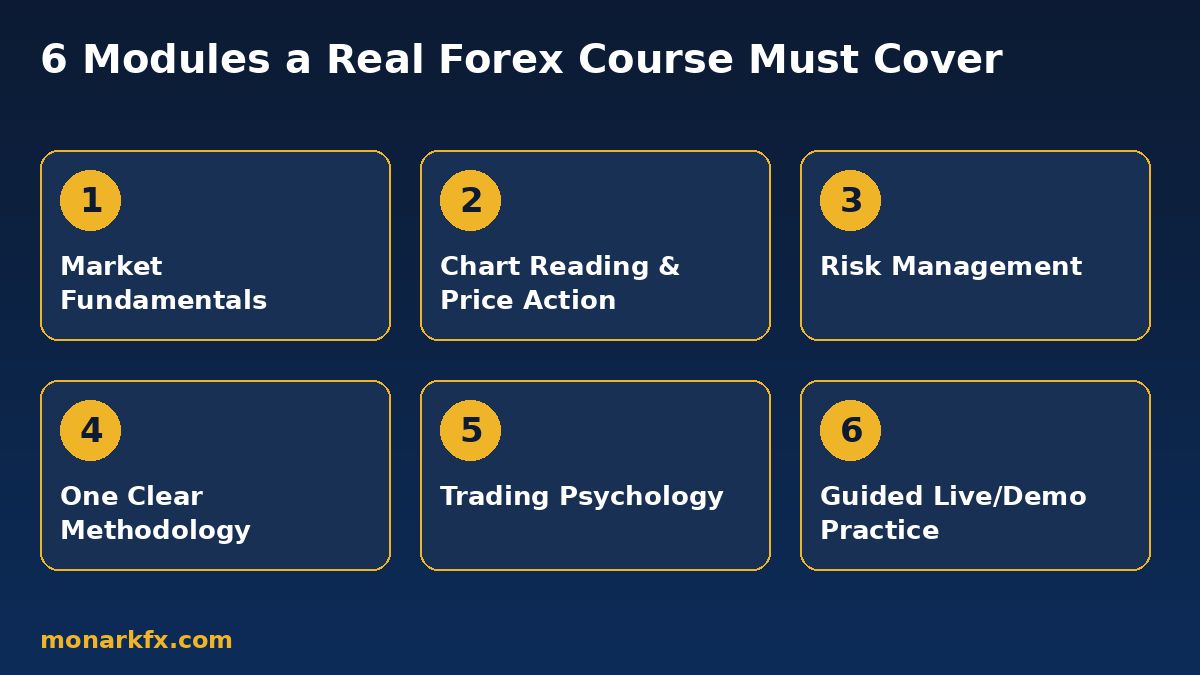
At minimum, a serious course walks through these in sequence. Not as a random mix.
- Market fundamentals: how currency pairs work, what moves them, and session timings (London, New York, Asian) and why timing matters for a trader sitting in India.
- Chart reading and price action: candlestick structure, support and resistance, trend direction. Without leaning on indicators like a crutch.
- Risk management: position sizing, stop-loss placement, and the simple maths of why risking 1–2% per trade matters more than any entry setup.
- One specific method: demand-supply, price action or another defined approach, taught consistently. Not a grab-bag of “strategies.”
- Trading psychology: handling losing streaks, revenge trading, and overconfidence after a good run. Most short courses skip this completely. Yet it decides long-term survival more than any technical skill.
- Live or guided practice: using all of the above on demo or live charts with feedback. Not just watching someone else trade.
Here’s a simple rule. If a syllabus jumps from “what is forex” to “advanced strategies” in a day or two, something in the middle got skipped. Usually it’s risk management and psychology, because they’re harder to sell than “advanced strategies.” New to all this? Our 6-stage forex training roadmap for beginners shows how these stages should flow.
Recorded, Live or Hybrid: What’s the Real Difference?
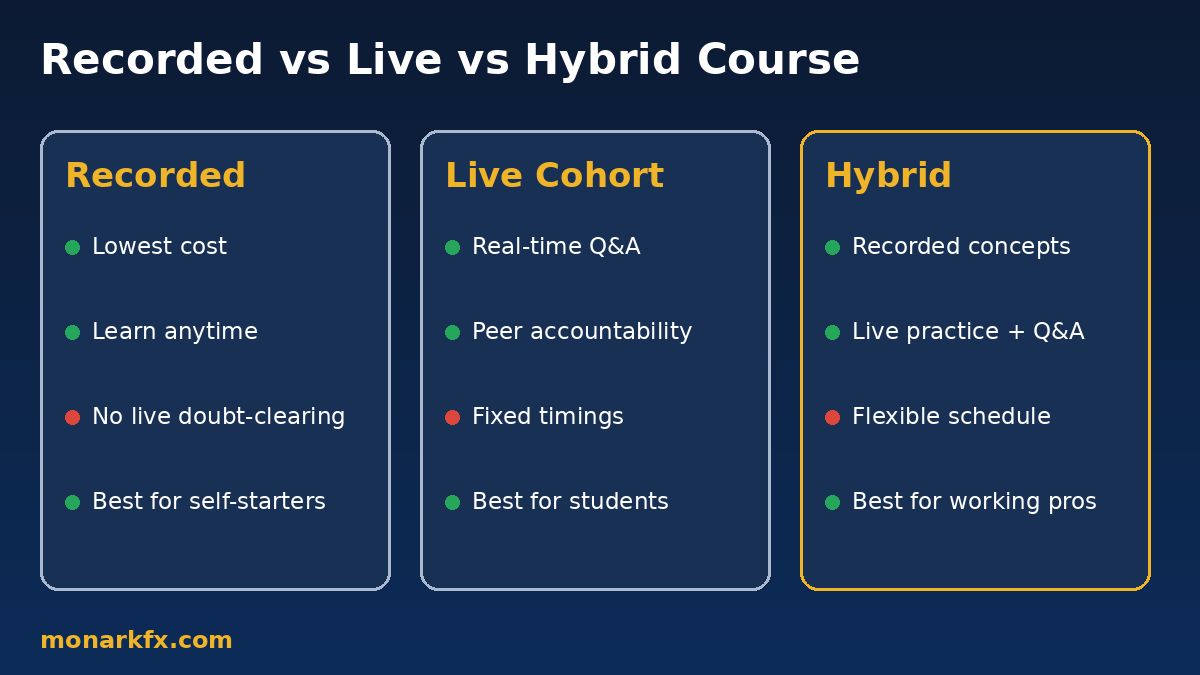
Recorded-only courses are the cheapest and easiest to scale. But they can’t answer your doubt about your chart. They work best as a supplement, not your whole education.
Live cohort courses run on a schedule with a group. You get real-time doubt-clearing and peer accountability. The catch is fixed timing, which doesn’t suit everyone, especially working professionals.
Hybrid courses mix recorded lessons for core concepts with live sessions for practice and Q&A. For most people I’ve mentored, this has been the most practical middle ground. No rigid daily attendance, but still real interaction.
None of these is “the best” for everyone. A disciplined self-starter can do fine with recordings. Someone who needs outside accountability will probably drop off without a live part.
Does a Forex Course Certificate Actually Matter?
This question comes up all the time, so let me be direct. A “certificate of completion” from a private forex course has no regulatory weight. It’s not the same as an NISM certification, which covers Indian securities markets. If a course sells its certificate as a job credential, be sceptical. It’s nice for your own record. It is not a licence, and any course implying otherwise is stretching the truth.
What matters far more is proof you can actually trade: a written trade journal, a demo account track record, or being able to explain the reasoning behind a trade to someone experienced.
A Comparison Framework Before You Enroll
Run any forex trading course online through this table before you pay. Yes, ours too.
| Factor | What to actually check |
|---|---|
| Curriculum sequence | Does it build from basics to application, or jump straight to “strategies”? |
| Risk management | A dedicated module, or one slide mentioned in passing? |
| Format | Recorded, live or hybrid, and does it match how you really learn? |
| Mentor transparency | Can they show real trade reasoning, not just profit screenshots? |
| Practice | Is there guided demo trading, or is it all theory? |
| Post-course access | Do doubts get answered after the last module, or does support stop? |
| Price vs inclusions | Is the fee about mentorship depth, or mostly slick videos and branding? |
The Legal Reality Indian Traders Often Skip
Course marketing rarely mentions this, and it should. Retail forex trading in India is regulated. SEBI and RBI allow residents to trade INR-based pairs (USD/INR, EUR/INR, GBP/INR, JPY/INR) plus a few permitted cross pairs, only on recognised exchanges like NSE and BSE through a registered broker. RBI also keeps an Alert List of unauthorised forex platforms.
A course that casually pushes offshore, unregulated brokers is skipping over a real legal risk. A trustworthy course talks about this openly, even though it complicates the pitch. We’ve broken down the rules in detail in forex trading in India for beginners: legal rules and pairs.
What I’ve Actually Seen Work
I’ll be upfront about my bias: I run a trading education setup. So treat this section as informed opinion, not neutral research.
Across the batches I’ve mentored, the fastest learners weren’t the ones who watched the most content. They kept a trade journal from week one. They reviewed every losing trade against their original plan. And they showed up to doubt sessions regularly, not just when something went wrong. Course structure mattered. Consistency mattered more.
One student, an accountant by profession, wrote a one-line reason before every single demo trade. Win or lose. Three months in, that one habit had done more for his consistency than any module we taught. A good course should push that behaviour on purpose, not leave it to luck.
What a Typical Week Looks Like in a Good Online Course
People often ask me what they’ll actually do each week. Here’s a rough picture of a well-run hybrid forex trading course online, based on how we run our own batches.
- Two or three short recorded lessons (20–40 minutes each) on one concept, say, marking demand and supply zones.
- One live session where the mentor marks the same concept on current charts and takes questions.
- Homework on a demo account: find five examples of that week’s setup, mark them, and note why.
- Journal review: you submit your trade notes, and someone actually reads them and replies.
That’s maybe 4–6 hours a week. Doable alongside a job. If a course expects much less than this, it’s probably light on practice. If it expects a lot more, check whether that’s realistic for your life before you pay.
How Much Does a Forex Trading Course Online Cost in India?
Prices are all over the place. You’ll see everything from ₹999 recorded bundles to ₹1 lakh+ “mentorship” programmes. Price alone tells you very little about quality.
A better way to think about it: what are you paying for? Videos are cheap to make once. Mentor time is not. So a fair price usually reflects live sessions, journal reviews, and how long support lasts after the course. If a high fee buys you only recordings and a certificate, that’s mostly branding.
And remember the real cost of a weak course isn’t the fee. It’s the money you lose later trading on half-learned ideas. Our guide to learning forex trading as a beginner covers what to master before you put any real capital at risk.
Who Each Format Actually Suits
Be honest about your own learning habits before you pick. Don’t just go with whatever a landing page recommends.
- Working professional with unpredictable hours? A fully live course will likely frustrate you. Missed sessions pile up fast. Hybrid usually fits better.
- Student or flexible schedule? A live cohort works well. The fixed timetable and peer group give you structure you might not build alone.
- Self-disciplined, done self-study before? A recorded course plus occasional one-on-one doubt sessions can be more cost-effective than a full live programme.
- Dropped a course before? Ask why. If it was accountability, pick a format with cohorts or check-ins. If the content got too advanced too fast, look for a course that spends real time on basics. Our 5-level beginner course roadmap is a good reference.
Prefer learning in a classroom in Delhi? We’ve also covered forex trading classes in Delhi and how they compare with online learning.
Common Mistakes Students Make Mid-Course
Even in a well-built course, the same few mistakes derail progress more often than any syllabus gap.
Skipping the demo phase because it “feels slow.” It’s boring on purpose. It builds repetition without real money at stake. Rushing past it to feel like you’re “really trading” is one of the most common reasons students blow up a live account in their first month.
Switching strategies mid-course. Watching another mentor’s reel and mixing their idea into what you’re learning usually creates confusion, not an edge. Finish one framework first.
Not reviewing losing trades properly. It’s natural to want to move on from a loss. But losers teach more than winners, if you actually figure out what went wrong instead of blaming “the market.”
Comparing yourself to classmates’ screenshots. Everyone starts from a different place, with different risk tolerance and screen time. A classmate’s early profit doesn’t mean your slower pace is wrong. Often it’s the more sustainable one.
Red Flags in Forex Course Marketing
- “Guaranteed” profits or income. No course can promise that, because markets don’t.
- Fake urgency like “only 5 seats left” that resets every week.
- Testimonials that show only profit screenshots, never the learning process or the losses.
- A vague mentor bio: “expert trader” with no strategy, years or verifiable record.
- No refund or trial policy visible before you pay the full fee.
How to Test a Course Before Paying Full Price
- Ask for one full sample module, not just a trailer clip.
- Ask straight out whether risk management and psychology have their own modules.
- Ask what happens after the course ends. Do doubts still get answered, or does access just expire?
- For a live cohort, ask to sit in on part of a session first, even just as an observer. You can also book a demo class to see how a mentor actually teaches.
If you want to see how we structure this at MonarkFX, including our demand and supply trading course, visit monarkfx.com and ask for a sample session before you decide anything.
Frequently Asked Questions
Is a paid forex trading course online worth it compared to free YouTube content?
Free videos can teach single concepts, but a well-structured paid forex trading course online gives you sequence, feedback and accountability. That structure and feedback loop is what you’re paying for, not the information itself.
Does a forex trading course certificate help in getting a job?
Usually not. Private course certificates have no regulatory recognition in India. They’re useful as a personal record, not as a professional credential like an NISM certification.
How much should a genuine forex trading course online cost in India?
Fees range from under ₹1,000 to over ₹1 lakh, and price alone isn’t a quality signal. Check whether the fee covers real mentorship: live doubt-clearing, demo practice, journal reviews and support after the course.
Can I do a forex trading course online while working full-time?
Yes. Hybrid courses that mix recorded lessons with scheduled live sessions usually fit working professionals best, needing roughly 4–6 hours a week.
Is it legal to take an international forex course while trading only INR pairs in India?
Yes. Learning forex concepts is not restricted. SEBI and RBI rules apply to what you trade and through which broker, not to the course content. Stick to permitted pairs on NSE or BSE through a registered broker.
How long does it take to learn forex trading through an online course?
Most beginners need at least 3–6 months of steady learning and demo practice before trading small real positions. Any course promising mastery in a few days is overselling.
About the author: Dinesh Verma has been actively trading Indian, forex and crypto markets since 2021 and mentors retail traders through MonarkFX in West Delhi and online. This article reflects patterns seen across real student batches, not a generic course comparison. It is for education only and is not investment advice.