
Forex School Online: 7 Honest Checks Before You Join One (2026)
Written by Dinesh Verma, Founder of MonarkFX. Trading Indian, forex and crypto markets since 2021 and teaching price action and demand-supply to retail traders from our West Delhi centre and online batches.
A student once asked me, “Sir, kya main sirf ek forex school online join karke ghar se trading seekh sakta hoon?” I told him yes, but with a condition. A forex school online works only when there is a real teacher on the other side who checks your charts, corrects your mistakes and stops you from going live too early. Without that, it is just a folder of videos with a nice logo.
I have taught both ways, in a classroom in Uttam Nagar and on video calls with people in smaller cities across India and a few based abroad. Some of my best students never saw our office. Some of my weakest had front-row seats. So the format is not the problem. How the course is built is what decides the result.
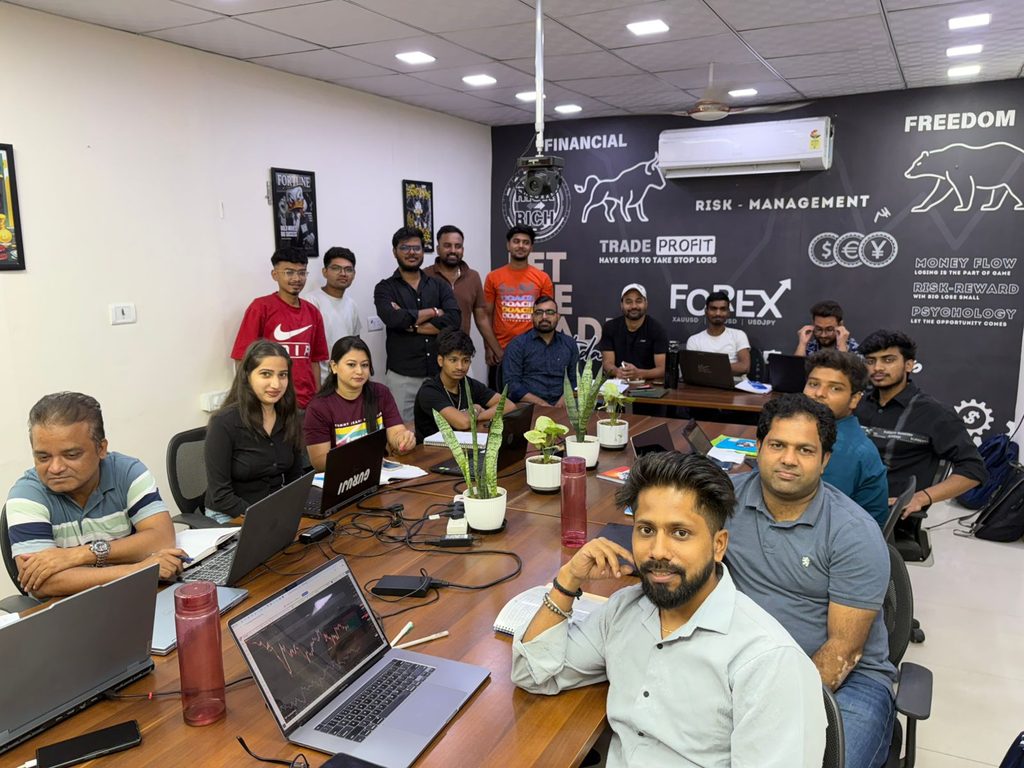
Below I have put down what I check, and what I tell my own students to check, before they pay any online forex school. No sales talk. Just the questions that save you money.
Table of Contents
What a Forex School Online Actually Is
A forex school online is a course that teaches you currency trading over the internet in a fixed order: how price moves, how to read a chart, how to size a position, how to cut a loss, and how to place a trade with a plan. The word “school” is the important part. A school has a syllabus, a teacher, homework and some way to see if you are improving.
A YouTube playlist is not a school, even if every video in it is correct. You can’t ask it a question at 9:40 pm when your EUR/USD trade hits stop loss and you don’t understand why.
Why So Many Traders Now Learn Online
Five or six years ago, serious forex classes in India were mostly offline and mostly in metro cities. If you lived in a small town, you either moved, travelled two hours each way, or learned alone. Video calls changed that.
Many of my online students live in towns with no trading institute nearby. For them, an online forex school is not about comfort. It is the only way they get access to a mentor at all. Recorded sessions and flexible timing are a bonus. Access is the real reason.
The Problem With Most Online Forex Schools
Here is the part most people learn the hard way. Many so-called schools are actually one of these three things:
- A video pack with no teacher. You watch, nobody checks, and you never find out what you misunderstood.
- A tips business with a course attached. The “lessons” exist to sell you daily calls or a paid Telegram group.
- A free webinar funnel. The free class is cut short on purpose so you buy the ₹40,000 programme on the spot.
Recorded videos are fine for revision. The trouble starts when these products call themselves a school while nobody is actually teaching.
7 Checks Before You Join a Forex School Online
These are the seven things I would ask about any forex school online, including ours. If a school can’t answer them clearly, keep your money.
1. Is there a written syllabus with a sequence?
Ask for the module list. You should see basics first, then chart structure, then risk and position sizing, then live market practice. If they say “everything is covered” but can’t show the order, it is a library, not a course.
2. Are there live doubt sessions every week?
A recorded lesson can explain a demand zone. It can’t tell you why your zone failed on Tuesday. Weekly live sessions where you share your screen and explain your trade are where most learning actually happens.
3. Do they make you practise on demo first?
Any school that pushes you to trade real money in week one is thinking about its upsell, not your skill. I keep students on demo for at least six to eight weeks so they see trending days, choppy days and news days before risking a rupee.
4. Can you verify the mentor’s background?
Online, it is easy to hide behind a smart landing page. Ask how long the mentor has traded, which markets, and whether they can walk you through the reasoning behind a real past trade, including a losing one. Screenshots of profits prove very little.
5. Is there a batch or community?
Most people who study alone from videos drop off by week three. In a batch, someone notices when you go quiet. That small pressure is often what gets a person through the boring middle part of learning.
6. What happens after the course ends?
Markets change. Ask if you keep access to recordings and doubt sessions after the last class. A school that locks the door on day 60 sold you a product, not an education.
7. Is the trading they teach legal in India?
This one is skipped by a lot of online schools. For Indian residents, forex trading is allowed only in specific currency pairs on recognised exchanges like NSE and BSE, through a SEBI-registered broker. Trading other pairs on overseas apps is not permitted under FEMA, and the Reserve Bank of India keeps an Alert List of unauthorised forex platforms. You can also check if a broker is registered on the SEBI website. If an online forex school tells you to open an account on an offshore app, walk away.
Forex School Online vs Offline Institute
People often ask me which one is better. Here is a plain comparison based on what I see in my own batches:
| Point | Online forex school | Offline institute |
|---|---|---|
| Who can join | Anyone in India with a laptop and net | People who live or work nearby |
| Fees | Usually lower, no rent or travel | Often higher because of office costs |
| Doubt clearing | Good only if live sessions are regular | Face to face, on the spot |
| Self-discipline needed | High, you must show up on your own | Lower, the timetable keeps you going |
| Peer group | Depends on the batch community | Comes naturally in the classroom |
Neither one wins every time. If you are disciplined and fine on video calls, online can work just as well, and you save the travel time. If you need someone physically sitting next to you, an offline trading institute may suit you better. You can also attend a free demo class first and decide.
A Real Example From an Online Batch
One of my students, I will call her Priya because she asked me not to use her name, joined from a town with no trading institute within 100 km. For the first two months she struggled. She would watch the recordings, feel sure of herself, and then freeze the moment a live chart started moving.
More videos did not fix it. What fixed it was putting her in a smaller live group where she had to say her reason for a trade out loud before clicking buy or sell. If she could not explain the entry, stop and target in one line, she skipped the trade. About six months in, she was trading very small live positions with a plan she could explain, not one she had copied.
That messy middle is what most online forex school ads never show. If every testimonial on a website is an “after” story with no “before”, be careful.
Red Flags to Watch For
- No proof of the mentor’s own trading, only “10 years of experience” written in a banner.
- Countdown timers like “offer ends in 2 hours” on an education product.
- No refund policy, or one hidden at the bottom of a long PDF.
- Testimonials that only talk about money made, never about losses or process.
- No named teacher, just a brand and rotating “experts”.
- Any promise of fixed monthly returns. No honest teacher can promise that.
Types of Online Forex Courses
Not every forex school online runs the same way. Knowing the format helps you compare fees properly.
- Self-paced videos: cheapest, good for revision, weakest for building real skill.
- Live batch (cohort): a group moves through the syllabus together with live classes. Usually gives the best results because of accountability.
- Hybrid: recorded lessons for theory plus live sessions for practice. Works well for working professionals.
- One-on-one mentoring: most personal and most expensive. Useful, but a well-run batch takes most beginners far enough.
If you want to see how a structured syllabus looks, our forex trading course roadmap for beginners lays out the modules week by week.
How Much Does a Forex School Online Cost in India?
Fees vary a lot, and price alone tells you very little. From what students tell me about other programmes and what we see in the market, the rough ranges look like this:
| Type of course | Typical fee range | What you usually get |
|---|---|---|
| Recorded video course | ₹2,000 to ₹15,000 | Lifetime videos, little or no live support |
| Live online batch | ₹15,000 to ₹50,000 | Weekly live classes, doubt sessions, demo practice |
| Hybrid programme | ₹20,000 to ₹60,000 | Recordings plus live practice sessions |
| One-on-one mentoring | ₹60,000 and above | Personal reviews of your trades |
These are broad market ranges, not fixed rates. Before paying any forex school online, ask for the fee in writing, what is included, how long you keep access, and the exact refund terms. A cheaper course with a teacher who replies is worth more than an expensive one where your doubts sit unanswered for a week.
Who Should Not Join a Forex School Online Yet
I say this to people on demo calls quite often, and it surprises them. An online forex school is not the right step for everyone right now. Hold off if:
- You plan to trade with money you need for rent, EMIs or fees. Learn first, fund later.
- You can’t give at least 5 to 6 hours a week for three months. The course will just become another unused login.
- You want a fixed monthly income from trading in the next few weeks. No honest course can give you that.
- You are not willing to keep a trade journal. Without it, nobody can find your mistakes, not even a good mentor.
If none of these apply, you are in a good position to get real value from a forex school online. If you are completely new and want to understand the basics before paying anyone, start with our free guide on how to learn forex trading as a beginner.
What Progress Looks Like After You Join
Here is a realistic timeline for someone who studies 1 to 2 hours a day and does the homework:
- Weeks 1 to 6: chart structure, basic price action, risk rules. All on demo. Lots of mistakes, none of them expensive.
- Weeks 6 to 12: demo results start to look steady. Confidence usually drops once before it settles. That is normal.
- Months 3 to 6: very small live trades, each one reviewed against the written plan.
- After month 6: slow increase in size, only if the process has stayed the same across many trades.
If an online school promises steady profits within a few weeks, treat that as a warning, not a selling point.
How to Test a School Before You Pay
- Attend the free intro session and ask the mentor directly about their own trading.
- Ask to see one full recorded live class, not a highlight clip, to see how doubts are handled.
- Find a past student outside the school’s testimonial page and ask how support was after payment.
If a school says no to all three, you have your answer. For a longer checklist on fees, refunds and mentor background, read how to evaluate a forex trading institute in India. And if you are still comparing brands, our guide on choosing the best forex academy in India covers what a good course should include.
Advanced Chart Concepts: SMC, ICT and Liquidity
Currency pairs like USD/INR and EUR/USD respect liquidity and order flow just like stocks. Once the basics are in place, our forex students also learn:
- Support and resistance and demand and supply zones as the base
- Liquidity: equal highs and lows, stop loss clusters and liquidity sweeps
- Smart Money Concepts (SMC): break of structure (BOS), change of character (CHoCH), order blocks and fair value gaps
- ICT ideas: premium and discount areas and session timing
- RSI divergence as confirmation at key zones, never as a standalone signal
These ideas are added in a fixed order so they sharpen your reading instead of cluttering the chart. Read more in our demand and supply trading course guide.
Frequently Asked Questions
Can I learn forex trading from a forex school online without offline classes?
Yes. You can learn forex trading fully online if the school runs regular live classes, checks your demo trades and clears doubts in real time. Recorded videos alone are rarely enough. What matters is structure and feedback, not whether the room is physical or virtual.
Is a forex school online cheaper than an offline institute?
Usually yes, because there is no rent or travel cost. Live online batches in India commonly cost between ₹15,000 and ₹50,000. Still, do not choose on price alone. A course with an active mentor is worth more than a cheap video pack.
How do I know if a forex school online is genuine?
Check five things: a written syllabus, a named mentor with a verifiable trading background, a demo practice phase before real money, a clear refund policy, and teaching only of forex trading that is legal in India through SEBI-registered brokers.
Is forex trading legal in India for students of an online school?
Forex trading is legal for Indian residents only in permitted currency pairs on recognised exchanges such as NSE and BSE, through a SEBI-registered broker. Trading on offshore apps is not allowed, and RBI publishes an Alert List of unauthorised platforms.
How long does it take to become consistent after joining a forex school online?
Most beginners need four to six months of steady practice with feedback before trading small amounts of real money with confidence. Anyone promising regular profits within a few weeks is overselling.
About the author: Dinesh Verma has traded Indian, forex and crypto markets since 2021 and runs MonarkFX, a trading education centre in West Delhi with online batches across India. This article is based on what he has seen while teaching online batches, not a generic overview.
4 Comments