
Forex Trading in India for Beginners: Legal Rules, Pairs and Easy First Steps (2026)
Written by Dinesh Verma, Founder of MonarkFX. Trading Indian, forex and crypto markets since 2021 and teaching price action and demand-supply to retail traders in West Delhi and online.
“Sir, forex trading in India legal hai ya nahi?” I hear this question in almost every demo class. The honest answer is: yes, but only one specific way. Most of the trouble Indian beginners get into comes from not knowing where that line is.
This guide is about forex trading in India specifically. Which pairs you can trade, where, through whom, how much money you need, how it’s taxed, and how to take your first trade without breaking any rule. If you need the general basics first (pips, lots, leverage), read our forex trading for beginners guide and come back.
Is Forex Trading in India Legal?
Table of Contents
Forex trading in India is legal for residents when three conditions are met:
- You trade only permitted currency pairs.
- You trade on a recognised Indian exchange such as NSE, BSE or MSE.
- You trade through a broker registered with SEBI.
Anything outside this, like trading EUR/AUD with 1:500 leverage on an app based abroad, is not allowed under the Foreign Exchange Management Act (FEMA). The Reserve Bank of India regularly updates an Alert List of unauthorised forex trading platforms and has warned the public many times against them. Money sent to such platforms through UPI or cards can also be frozen, and recovering it is very hard.
Currency Pairs You Can Trade in India
| Type | Pairs allowed on Indian exchanges |
|---|---|
| INR pairs | USD/INR, EUR/INR, GBP/INR, JPY/INR |
| Cross-currency pairs | EUR/USD, GBP/USD, USD/JPY |
These are traded as futures and options contracts. USD/INR is by far the most liquid, which is why most people doing forex trading in India start with it.
How to Verify Your Broker
Before opening an account, check the broker’s name and registration number on the SEBI website. Also confirm that the broker offers the currency derivatives segment on NSE or BSE. Most large Indian stock brokers do. If a “broker” contacts you on WhatsApp, offers bonus money on deposit or asks you to pay into a personal account, it is not a legal route.
How Much Money Do You Need?
On NSE, one USD/INR futures contract is 1,000 US dollars. At a rate near 84, that is a contract value of about ₹84,000. You don’t pay the full amount. You only keep margin, which is usually a small percentage of the contract value and changes with volatility. Your broker shows the exact margin before you place the order.
For learning, I suggest starting with a capital you can afford to lose fully without stress, trading one lot at a time, and risking only about 1% of that capital on each trade.
Forex Trading Timings in India
- INR pairs: 9:00 am to 5:00 pm IST, Monday to Friday.
- Cross-currency pairs: 9:00 am to 7:30 pm IST.
- Markets are closed on exchange holidays.
The morning session and the London open (roughly 12:30 pm to 2:00 pm IST) usually see the most activity in INR pairs.
How Forex Profits Are Taxed in India
Profit from exchange-traded currency futures and options is generally treated as non-speculative business income and taxed at your income tax slab rate. You may need to file ITR-3 and, above certain turnover limits, get a tax audit. Tax rules change, so speak to a chartered accountant once you start trading actively.
Step-by-Step: Your First Trade in Forex Trading in India
- Learn the basics. Pairs, lot size, margin and stop loss. Practise on a demo or paper account for six to eight weeks.
- Choose a SEBI-registered broker that offers the currency segment.
- Activate the currency derivatives segment in your trading account. Your broker may ask for income proof.
- Pick one pair, usually USD/INR, and study its daily range and behaviour.
- Write your trade plan: entry, stop loss, target and the reason, before you click buy or sell.
- Trade one lot, follow the plan, and record the trade in your journal.
For a structured learning plan, follow our forex trading training roadmap. For a guided programme with live practice, see our forex trading course in India.
What Drives the Rupee
- US Federal Reserve and RBI interest rate decisions
- Crude oil prices, since India imports most of its oil
- Foreign investor buying or selling in Indian stocks and bonds
- India’s trade deficit and inflation data
- RBI intervention to smooth sharp moves
Because RBI often steps in, USD/INR tends to move in a tighter range than many global pairs. That makes forex trading in India calmer than what you see in offshore forex videos, which is good for beginners.
Common Mistakes Indian Beginners Make
- Opening an offshore account because of high leverage or “deposit bonus”.
- Paying for signals on Telegram instead of learning the process.
- Trading big size before understanding margin.
- Ignoring tax filing on trading income.
- Trading during RBI or US Fed announcements without a plan.
Is Forex Trading in India Good for Beginners?
It can be. The legal route through Indian exchanges gives you regulated brokers, transparent pricing and lower leverage, which protects beginners from the biggest risk: blowing up quickly. The trade-off is fewer pairs and fixed timings. For most people starting out, that is a fair deal.
If you want to learn with a mentor, read how to evaluate a forex trading institute first, or book a free demo class at our West Delhi centre.
Advanced Chart Concepts: SMC, ICT and Liquidity
Currency pairs like USD/INR and EUR/USD respect liquidity and order flow just like stocks. Once the basics are in place, our forex students also learn:
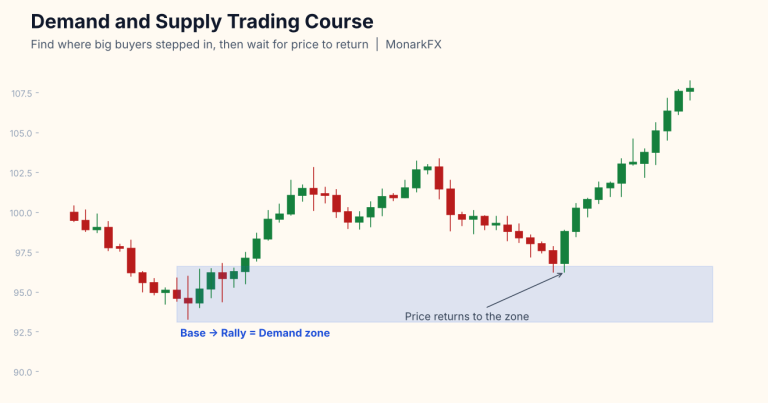
- Support and resistance and demand and supply zones as the base
- Liquidity: equal highs and lows, stop loss clusters and liquidity sweeps
- Smart Money Concepts (SMC): break of structure (BOS), change of character (CHoCH), order blocks and fair value gaps
- ICT ideas: premium and discount areas and session timing
- RSI divergence as confirmation at key zones, never as a standalone signal
These ideas are added in a fixed order so they sharpen your reading instead of cluttering the chart. Read more in our demand and supply trading course guide.
Frequently Asked Questions
Is forex trading in India legal?
Yes, forex trading in India is legal for residents only in permitted currency pairs on recognised exchanges like NSE and BSE, through a SEBI-registered broker. Trading on offshore forex apps is not permitted under FEMA.
Which currency pairs are allowed in India?
USD/INR, EUR/INR, GBP/INR and JPY/INR, plus the cross pairs EUR/USD, GBP/USD and USD/JPY, traded as futures and options on Indian exchanges.
What are the timings for forex trading in India?
INR currency pairs trade from 9:00 am to 5:00 pm IST and cross-currency pairs until 7:30 pm IST, Monday to Friday, except exchange holidays.
How is forex trading income taxed in India?
Profit from exchange-traded currency derivatives is generally treated as non-speculative business income and taxed at slab rates. Consult a chartered accountant for your situation.
Can I trade forex in India with a small amount?
Yes. You only need margin for one lot, which is a small part of the contract value. Beginners should risk only around 1% of their capital per trade.
About the author: Dinesh Verma has traded Indian, forex and crypto markets since 2021 and runs MonarkFX, a trading education centre in West Delhi. This article is for education only and is not legal or tax advice.
3 Comments