
Forex Trading Classes: What Happens Inside One & How to Pick the Right Batch (2026)
By Dinesh Verma | Founder, MonarkFX — 6+ years of price-action and demand-supply trading, mentoring retail traders across India since 2021
Someone asked me last week, “Sir, forex trading classes join karne ka matlab kya hota hai actually — kya bas Zoom pe baithke lecture sunna hota hai?” It’s a fair question, because most people have never actually sat through one before enrolling, and the marketing pages don’t really describe what a class feels like — they just list features.
So this article is less about ranking classes and more about setting honest expectations: what real forex trading classes look like session to session, how batch size and schedule actually affect your learning, and what questions to ask before you commit your evenings — or your weekends — to one.
This ties closely to a few things we’ve already covered — how to judge a full forex trading institute in India, what a forex school online should include, and how to evaluate a forex trading course online and its syllabus. Classes are the actual delivery format underneath all of those — the recurring sessions where teaching happens. This piece is about that specific layer.
Class, Course, School, Institute — Why the Words Actually Differ
People use these words interchangeably, but they describe different things, and knowing the difference helps you ask sharper questions when you’re evaluating options.
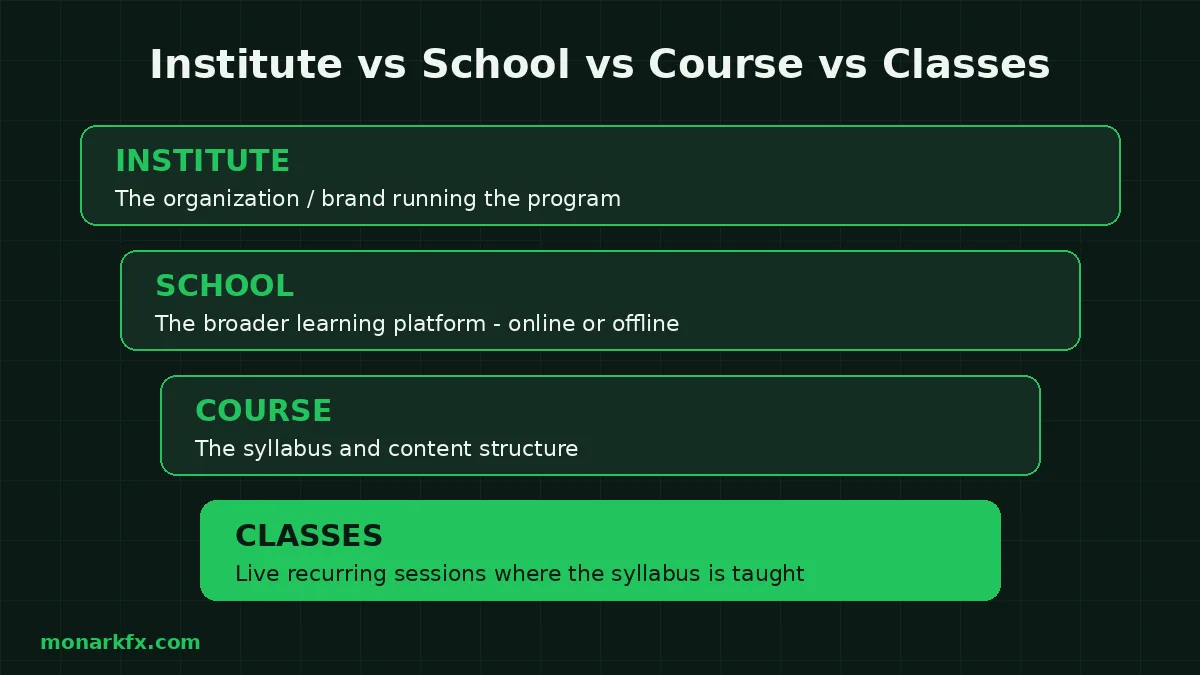
- Institute — the overall organization or brand running the program.
- School — often refers to the broader educational platform, online or offline.
- Course — the syllabus and content structure being taught.
- Classes — the actual recurring sessions where that syllabus gets delivered, live, to a batch of students.
You can have an excellent course with poorly run classes — badly paced, rushed, or with a mentor who doesn’t manage a room (physical or virtual) well. The syllabus on paper and the lived experience of attending are two different things, and “forex trading classes” as a search term is usually people trying to understand that lived experience before they commit.
What a Genuine Forex Trading Class Session Actually Looks Like
Having run more of these than I can count at this point, here’s roughly how a well-structured session goes, whether it’s in a physical room or over a video call:
- A quick recap of the previous class — five to ten minutes connecting back to what was covered, not starting cold.
- New concept introduction — chart examples, not abstract theory. If a class spends twenty minutes on definitions before showing a single real chart, that’s a pacing problem.
- Live chart walkthrough — applying the concept to a real or recent market example, ideally with student questions interrupting naturally, not held until “the end.”
- A practice task — something to apply before the next session, whether it’s marking support/resistance on a chart or journaling a demo trade.
- Open doubt-clearing — genuinely open, not a rushed five minutes at the end because the session ran long on theory.
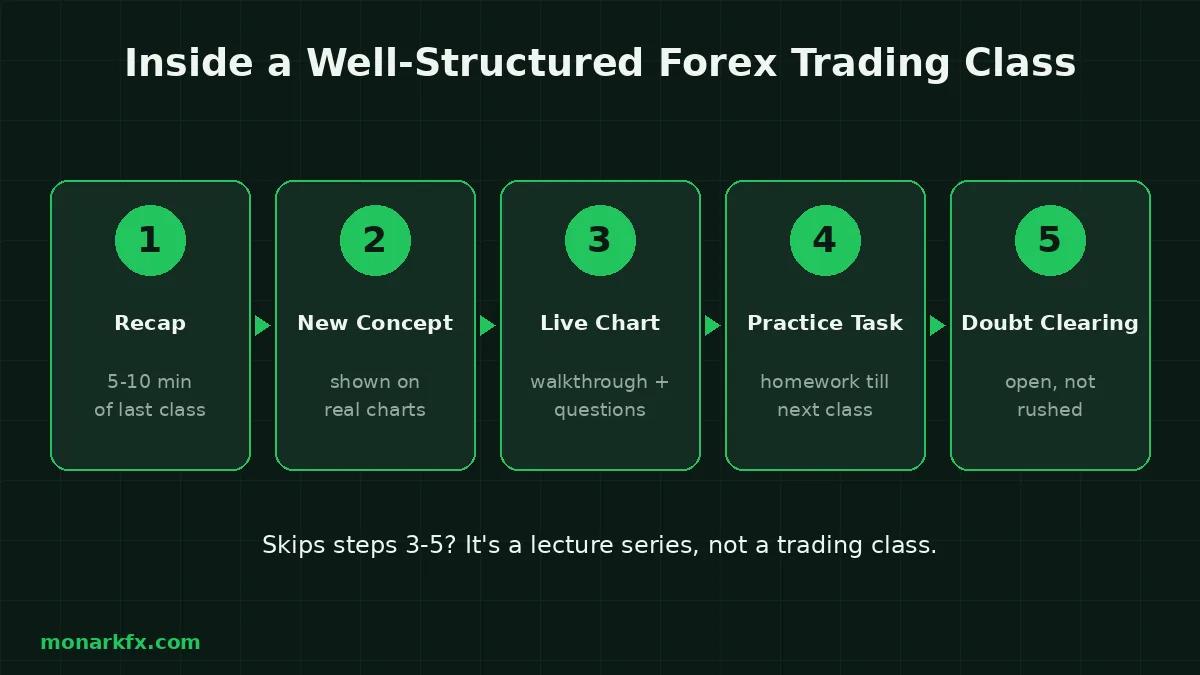
If a class you’re evaluating skips steps 3 through 5 consistently, it’s closer to a lecture series than an actual trading class. If you’re completely new, it helps to first read our forex trading basics for beginners so the first few sessions don’t feel overwhelming.
Batch Size in Forex Trading Classes: The Detail Most People Ignore
This is, in my experience, the single most underrated factor in whether forex trading classes actually work for someone. A class of 8-15 students allows a mentor to notice who’s quietly lost. A class of 100+ students in a “live” format is functionally a webinar — you can ask a question in the chat, but there’s no real way for the instructor to track your individual progress.
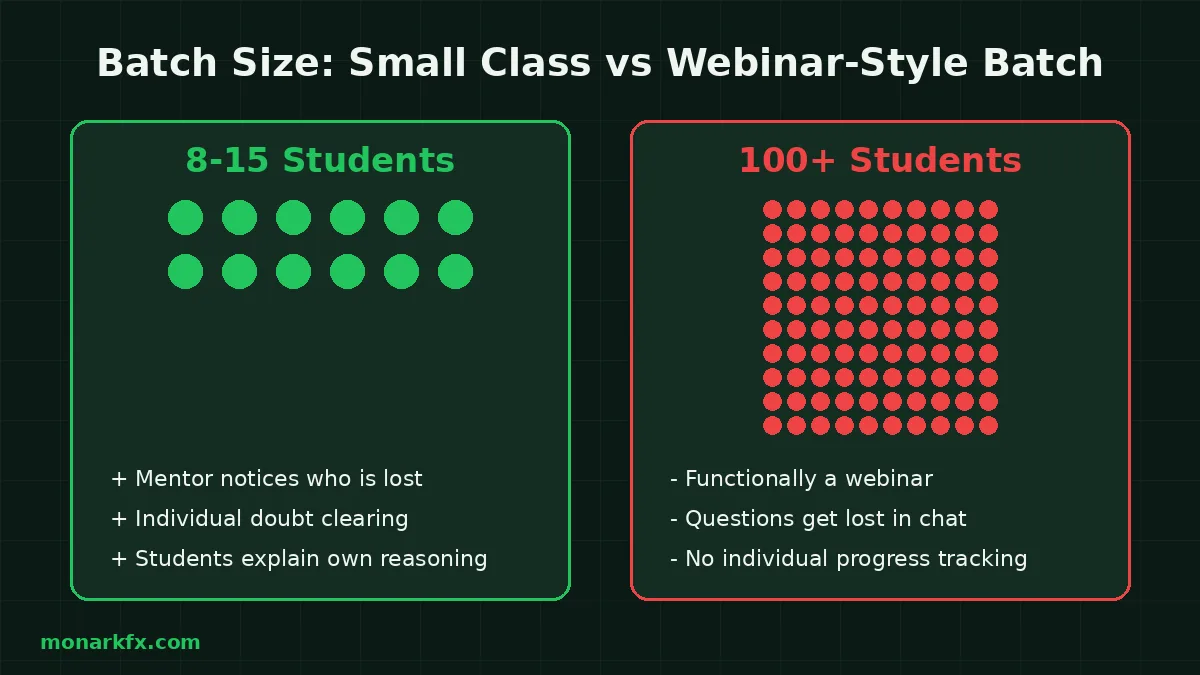
I’ve had to actively resist the temptation to oversell batch size, because larger batches are more profitable to run. But smaller batches consistently produce students who can explain their own reasoning, not just repeat what they were shown. If you’re comparing two otherwise similar classes, batch size is worth asking about directly — most marketing pages conveniently leave this number out.
Weekday vs. Weekend Classes — A Real Tradeoff
Weekday evening classes suit people with predictable 9-to-5 jobs and enough energy left after work to focus for 60-90 minutes. The downside: consistency suffers if your job has unpredictable hours or frequent late meetings.
Weekend classes work better for people whose weekday schedule is genuinely unreliable, but the gap between sessions (often a full week) means concepts need more deliberate personal revision in between, or they fade before the next class picks up.
Daily short sessions (30-45 minutes) are less common but can work well for building a habit quickly, especially in the first month, though they demand more day-to-day commitment than either of the above.
There’s no universally “better” schedule — the right one is the one you can actually attend consistently for the length of the program, not the one that sounds most intensive on a sales call.
Online vs. In-Person Forex Trading Classes
An in-person class in a physical location — say, our forex trading classes in Delhi — gives you a room full of peers, a whiteboard you can point at mid-discussion, and a mentor who can glance at your screen and immediately spot what you’re doing wrong. That kind of real-time correction is genuinely harder to replicate over video.
An online class trades some of that immediacy for reach — someone joining from a smaller town without a local institute nearby gets access they simply wouldn’t otherwise have. Screen-sharing and breakout rooms close most, though not all, of the gap. If you’d rather study on your own first, our 90-day plan to learn forex trading at home is a good starting point.
Neither format is objectively superior. What actually determines the outcome is whether the mentor actively manages engagement — calling on quiet students, checking screens or shared work, and not just talking at a room (physical or virtual) that’s gone passive.
Questions Worth Asking Before You Join Any Batch
- How many students are typically in a live batch — not the maximum capacity, but the actual usual number?
- Is attendance tracked, and is there a fallback (recording, catch-up session) if I miss a live class?
- How much of each session is live chart application versus static slides?
- What happens if I fall behind the rest of the batch — is there a way to get individual catch-up time?
- Can I sit in on a portion of one class, even as an observer, before enrolling? (Most good institutes offer a free demo class for exactly this.)
Any class worth joining should have straightforward answers to all five. Vague or deflecting answers to the batch-size question specifically is one of the more reliable red flags I’ve noticed over the years.
What You Should Actually Bring to Every Class
This gets overlooked because it sounds too basic to mention, but it’s one of the clearest predictors of who progresses and who plateaus. Students who bring the same three things to every session — a running trade journal, a list of specific unresolved doubts from practice, and last class’s notes reopened rather than forgotten — consistently outpace those who show up only to passively watch.
Classes work best as a feedback loop, and a feedback loop needs something to feed back on. If you’re attending purely to absorb, without applying anything in between sessions, the class format itself, however well-run, won’t compensate for that gap on its own.
How Long Forex Trading Classes Should Realistically Run
Marketing pages love round numbers — “master forex in 7 days,” “become a trader in 2 weeks.” In my experience, actual skill-building through classes realistically takes longer, and compressing it doesn’t speed up the underlying learning curve, it just skips steps.
A reasonable structure looks something like this: 4-6 weeks of fundamentals and chart reading classes, followed by 4-6 weeks layering in a specific methodology with guided demo practice, and then an extended period — often another couple of months — of lighter-touch mentorship as live trading (in small size) begins. Our 6-stage forex training roadmap for beginners breaks this down stage by stage.
Programs that compress all of this into a week or two aren’t more efficient; they’re usually just skipping the demo-practice and psychology components entirely, because those don’t fit into a short, sellable timeline.
Instructor-to-Student Ratio Beyond Just Batch Size
Batch size gets discussed often, but the instructor-to-student ratio across an entire program matters just as much and gets mentioned far less. A single mentor running five simultaneous large batches, even if each one individually looks reasonably sized on paper, has far less bandwidth per student than the numbers alone suggest.
Ask not just “how many students per batch,” but “how many total students does this mentor personally handle doubt-clearing for in a given week.” The honest answer to that second question tells you more about the actual attention you’ll receive than the batch-size figure alone.
A Story Worth Sharing Honestly
A few batches ago, I had a student who was consistently quiet in a slightly larger group — not disengaged, just naturally reserved in a room full of more vocal classmates. It would have been easy to miss that he was actually struggling with a specific concept, because he never raised his hand.
It only came up because I’d started a habit of asking two or three students directly, by name, to walk through their reasoning each session, rotating through the batch. When his turn came, it became obvious he’d misunderstood how stop-loss placement worked relative to structure, not indicators. That correction wouldn’t have surfaced in a passive, large-batch format — nobody would have noticed until a real trade went wrong.
That’s the argument for smaller, actively managed classes in one sentence: they surface the quiet misunderstandings before the market does.
Red Flags Specific to How Forex Trading Classes Are Marketed
- “Unlimited batch size, everyone welcome” framed as a benefit — it’s usually a capacity decision dressed up as inclusivity.
- No mention of what happens if you miss a class — a program with zero flexibility for real-life interruptions isn’t accounting for how people actually live.
- Celebrity endorsements or generic “as seen on” badges used as the primary trust signal instead of specifics about the actual class experience.
- Placement guarantees attached to trading classes — trading skill and job placement are different outcomes, and a program conflating the two is stretching its claims.
- Guaranteed-profit or “fixed monthly return” promises — no genuine mentor can promise this, and it often signals a disguised investment scheme rather than a class.
Also remember that in India, forex trading is legal only in INR-based currency pairs on SEBI-recognised exchanges through registered brokers. The RBI maintains an Alert List of unauthorised forex trading platforms — any class pushing you toward one of those is a serious red flag. We’ve covered the rules in detail in forex trading in India for beginners: legal rules and first steps.
Frequently Asked Questions
How are forex trading classes different from a forex trading course?
A course refers to the syllabus and content structure; classes are the actual live sessions where that syllabus is delivered and discussed. You can judge a course by its outline, but you can only judge classes by how they’re actually run.
What is a reasonable batch size for forex trading classes?
Somewhere in the range of 8-15 students allows genuine individual attention. Larger batches can still work if there’s a structured doubt-clearing system, but expect less direct interaction per person.
Are online forex trading classes as effective as in-person ones?
They can be, provided the mentor actively manages engagement — calling on students, reviewing shared screens, and not just presenting to a passive audience. The format matters less than how actively it’s run.
How many days a week should forex trading classes be held?
There’s no fixed ideal — 2-3 sessions a week is common and allows time to practice between classes without losing momentum. Daily classes can work for fast initial habit-building but require more consistent time commitment.
What should I do if I miss a live forex trading class?
Ask this before enrolling. A well-run program should offer either a recording or a brief catch-up option, since real-life schedule conflicts are inevitable over a multi-week program.
Ready to See a Real Class Before You Decide?
If you’re in Delhi NCR, the simplest way to judge any batch is to sit in on one. MonarkFX runs small, actively managed batches covering price action, demand-supply, SMC and risk management — book a free demo class at MonarkFX and see the session format for yourself before you pay anything.
About the author: Dinesh Verma has been actively trading Indian, forex, and crypto markets since 2021 and mentors retail traders through MonarkFX. This article is based on real patterns observed across live batches, not a generic promotional overview. Trading involves risk; nothing here is investment advice.