
How to Learn Stock Market in India: The Ultimate Step-by-Step Guide for Beginners
Dinesh Verma | Stock Market Educator & Trader, 6+ Years Experience | Personally traded Nifty & BankNifty using demand supply zones for 6+ years | Published: June 2026 | Last Updated: June 2026
- Mastering the basics of NSE and SEBI guidelines is your first crucial step before risking real capital.
- You can discover how to learn trading for free through reliable charting platforms like TradingView and trusted community educators.
- Identifying the best trading courses that teach price action and demand-supply zones will drastically accelerate your learning curve.
- Consistent practice through paper trading is essential before transitioning into real equity, forex, or crypto markets.
- Start small and prioritize risk management over quick profits to survive and thrive during your first year as a trader.
100-WORD QUICK ANSWER
To figure out how to learn stock market effectively, beginners must start by understanding core financial concepts and index structures like Nifty and BankNifty. Next, open a demat account just to observe live price action. You can initially explore how to learn trading for free using platforms like TradingView. However, for structured and accelerated growth, enrolling in the best trading courses that focus strictly on demand-supply zones is highly recommended. Always practice on a simulator before deploying real money. By treating trading as a serious business and managing risk, you build a foundation for consistent, long-term profitability.
SUMMARY COMPARISON TABLE
| Learning Method | Cost Element | Best For | Pros & Cons |
| Self-Taught (YouTube/Blogs) | Free to very low | Absolute beginners exploring basic concepts | Pros: Flexible. Cons: Information overload, lack of structure. |
| Paid Trading Courses | Medium to High | Serious beginners wanting a step-by-step system | Pros: Structured, faster learning curve. Cons: Requires upfront investment. |
| Mentorship / Live Classes | High | Traders wanting real-time demand-supply feedback | Pros: Personalized guidance. Cons: Expensive, requires strict time commitment. |
TABLE OF CONTENTS
- What is the Stock Market and How to Learn It?
- How Does It Work? / Step-by-Step Process
- Key Facts, Data & Statistics (Updated June 2026)
- Benefits of Learning the Stock Market Properly
- Common Mistakes / Challenges
- Expert Opinions / Real-World Examples
- Latest Updates & Trends in the Stock Market — 2026
- Future Outlook — What’s Coming Next?
- People Also Ask
- Frequently Asked Questions (FAQ)
What is the Stock Market and How to Learn It?
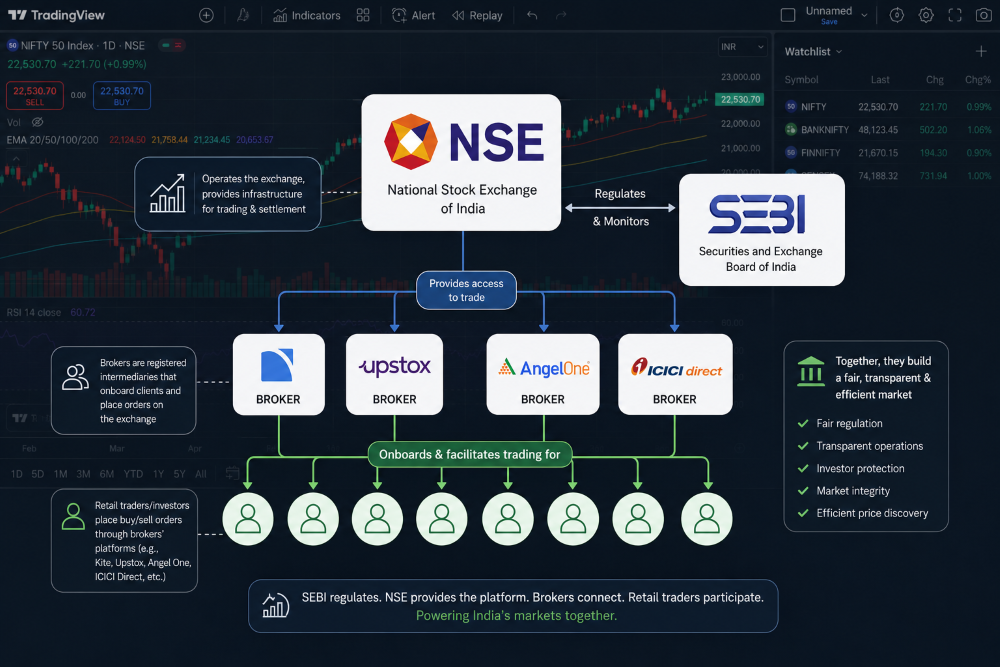
Understanding how to learn stock market dynamics begins with grasping what the market actually represents. At its core, the stock market is a centralized network where buyers and sellers trade shares of publicly listed companies. In India, the primary exchanges facilitating this are the NSE (National Stock Exchange) and BSE. The entire ecosystem is strictly regulated by SEBI to protect investors and maintain market transparency.
Share market seekhna ek din ka kaam nahi hai; it is a journey of understanding human psychology and price movement. Many beginners jump directly into buying options or exploring crypto classes without understanding the foundational auction process. When you buy a stock, you are buying a fractional ownership piece of that underlying business. The most effective way to decode market behavior is through price action and demand-supply theory. Instead of relying on lagging indicators, successful traders use tools like TradingView to analyze where institutional money is stepping in. Whether your goal is long-term investing or short-term intraday trading, building a solid theoretical foundation is mandatory before executing your first live trade.
How Does It Work? / Step-by-Step Process
Mastering the financial markets requires a structured approach. Jumping into live trades without a plan is a guaranteed way to lose capital. Here is a proven, step-by-step roadmap for beginners.
- Clear the Basics First: Start by understanding market terminology. Know the difference between equity, futures, and options. Spend your first few weeks observing charts on platforms like TradingView to see how prices move during live hours.
- Consume Free High-Quality Content: Figure out how to learn trading for free by following trusted educators. For instance, studying the historical chart breakdowns by experts like niftynitesh can give you a solid grasp of how Nifty behaves at critical support and resistance levels.
- Find the Right Structured Education: While free content is great for basics, you eventually need a proven system. Instead of endlessly searching for a local “course near me,” look for the best trading courses online that specifically teach pure price action and risk management. Good stock trading courses for beginners will always prioritize capital protection over profit generation.
- Master Demand and Supply: Enroll in the best demand supply classes to understand where institutional buyers and sellers are trapped. This is the core strategy for trading Nifty and BankNifty effectively.
- Forward Test via Paper Trading: Execute your learned strategies on a simulator for at least two months. Do not deploy real money until your paper trading account shows consistent month-over-month growth.

Key Facts, Data & Statistics (Updated June 2026)
Data-driven decision-making separates professional traders from gamblers. Here are the most critical market statistics shaping the Indian trading landscape right now.
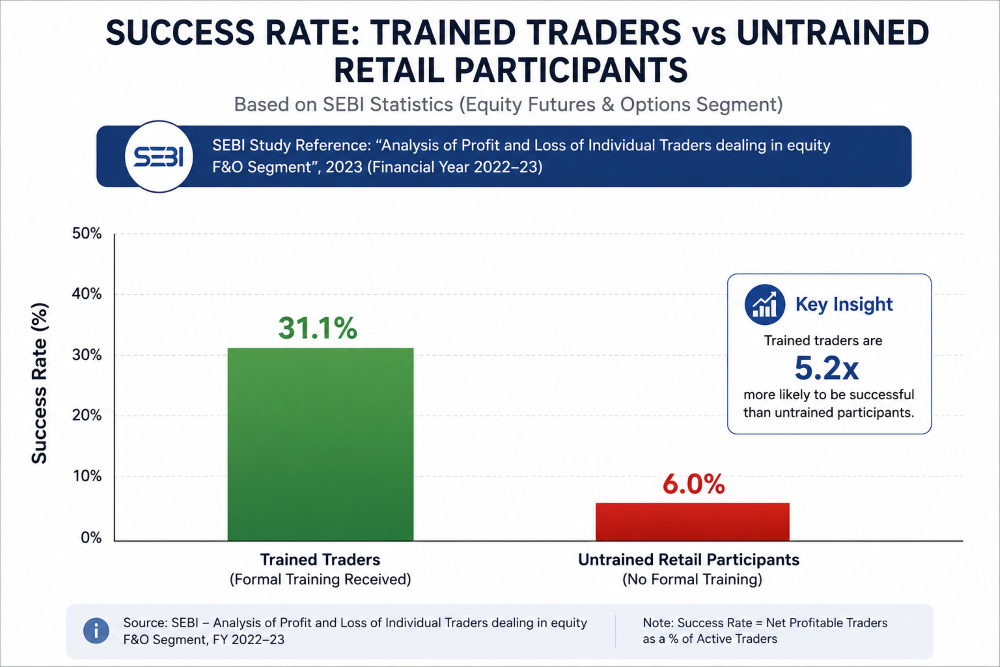
- Over 175 million active Demat accounts are registered in India, showing massive retail participation. — SEBI Data Report, 2026
- Nearly 89% of active retail equity option traders lose money consistently. — https://www.sebi.gov.in/
- T+0 (same day) trade settlement is now accessible for top 500 stocks, radically improving market liquidity. — NSE Circular, 2026
- Algorithmic trading accounts for roughly 60% of total daily volume on the NSE. — Financial Markets Survey, 2025
- Demand for localized financial education is surging, with regional language and Hinglish stock trading courses for beginners seeing a 40% year-over-year enrollment growth. — monarkfx
Benefits of Learning the Stock Market Properly
Financial Independence and Wealth Creation
The most obvious benefit of learning how to navigate the market is the potential for wealth generation. Jab aap market ko sahi tareeqe se samajhte hain, you stop relying solely on a fixed monthly salary. By mastering demand and supply zones, you can generate consistent secondary income. Over time, compounded returns from well-timed investments can lead to genuine financial independence, outperforming traditional fixed deposits or savings accounts.
Location Independence and Flexibility
Trading offers the ultimate geographic freedom. You do not need an office or a boss. As long as you have a stable internet connection, a laptop, and access to TradingView, you can analyze charts and execute trades from anywhere in the world. Whether you eventually transition into full-time forex trading or stick to Indian equities, the skillset is universally applicable across borders and time zones.
Developing Elite Psychological Discipline
Stock trading forces you to conquer your own emotions. Taking the best trading courses won’t just teach you technical analysis; they teach you risk management and emotional control. Market aapke patience aur discipline ka daily test leta hai. Learning to accept small losses gracefully and stick to a trading plan builds a level of psychological resilience that positively impacts every other area of your life.
Deep Understanding of Global Economics
When you learn the stock market, you inadvertently learn how the world works. You begin to understand how inflation, interest rates, and geopolitical events affect asset prices. By following guidelines from SEBI and tracking institutional footprints, you develop a macroeconomic perspective. This financial literacy protects you from scams and poor financial advice, making you a smarter manager of your own capital.
Common Mistakes / Challenges
The journey to trading mastery is filled with expensive traps. Recognizing these early errors can save your capital.
Trading Without a Stop Loss
This is the deadliest sin in trading. Bina stop loss ke trade karna is like driving a car without brakes. Beginners often hold onto losing positions hoping the price will bounce back. The consequence is devastating: a single bad trade can wipe out weeks of profits or blow up the entire trading account. Professional traders know their exit point before they ever enter a trade.
Overleveraging and Position Sizing Errors
Many new traders use excessive margin to chase big profits with small capital. Taking massive quantities in BankNifty options without understanding the delta can destroy your portfolio in minutes. You must learn proper position sizing—never risking more than 1-2% of your total capital on a single setup. Complete Guide to Risk Management — monarkfx.com
Strategy Hopping (The Shiny Object Syndrome)
Beginners constantly search for the “holy grail” indicator. They try price action on Monday, moving averages on Tuesday, and switch to different crypto classes by Friday. This inconsistency prevents you from gathering enough data to know if a strategy actually works. The real edge comes from mastering one specific method, like trading demand and supply zones, and executing it flawlessly over hundreds of trades.
Expert Opinions / Real-World Examples
To truly grasp how to learn stock market mechanics, we must look at how professionals approach the tape. Retail traders often focus on patterns, but institutional traders focus on liquidity and order flow.
A representative expert view in the modern Indian trading community highlights this shift: “Retail traders lose because they trade what they feel, not what the chart shows. Institutional buying leaves a footprint. If you map out demand and supply zones accurately on Nifty or BankNifty, you aren’t predicting the market; you are simply riding the coattails of big money.”
Consider a real-world scenario from recent NSE data. When a major blue-chip stock faces a temporary negative news catalyst, retail traders typically panic sell. However, experienced price action traders look for historical demand zones on the daily timeframe. If the price drops into a heavily defended demand zone and shows rejection (like a bullish pin bar), professionals enter long positions while retail is selling. This is why financial literacy and structured education are non-negotiable. Regulators like SEBI continuously warn about the dangers of derivatives trading for the uneducated, proving that survival depends entirely on your edge and risk management framework.
Latest Updates & Trends in the Stock Market — 2026
As of June 2026, the trading landscape in India has evolved rapidly, demanding that beginners stay updated with the latest structural changes.
First, the complete rollout of the T+0 (same day) settlement cycle across major NSE stocks has drastically shifted intraday liquidity dynamics. Capital is freed up instantly, allowing for faster capital rotation but also increasing intraday volatility. Beginners must adjust their risk parameters to account for these sharper market moves.
Second, the integration of AI-assisted charting on platforms like TradingView has become standard. While AI can highlight basic candlestick patterns, it cannot interpret complex market context or institutional demand zones. Therefore, manual price action skills are more valuable than ever. AI tools aapki help kar sakte hain, but execution ka decision aapka hi hona chahiye. Finally, regulatory tightening by SEBI regarding fin-fluencers has cleaned up the educational space. It is now much easier to identify the best trading courses because educators are required to be transparent about their credentials and real-world trading experience.
Future Outlook — What’s Coming Next?
Looking ahead, the Indian stock market is positioned for significant structural shifts that will impact how new traders learn and execute.
Hyper-Personalized Algorithmic Tools for Retail: Over the next few years, retail traders will gain access to institutional-grade execution algorithms at a fraction of the cost. However, the foundational knowledge of demand and supply will remain the primary differentiator between those who program winning algorithms and those who lose money automatically.
Convergence of Asset Classes: The lines between traditional equities, forex, and digital assets are blurring. Beginners who learn price action today will find it incredibly easy to transition. The exact same demand and supply concepts used on Nifty can be applied seamlessly if you decide to take advanced forex or crypto classes in the future. Price is simply a reflection of human emotion, and that remains constant across all global markets.
People Also Ask
Yes, you can learn the stock market on your own using free resources, YouTube tutorials, and reading financial books. However, self-learning often takes significantly longer and involves costly trial-and-error mistakes. Enrolling in structured stock trading courses for beginners provides a clear roadmap and accelerates your journey to profitability.
It typically takes 6 to 12 months to grasp the foundational concepts and develop a working strategy. Achieving consistent profitability can take 1 to 3 years of dedicated practice. Trading ek skill hai, and just like a degree, it requires sustained screen time, backtesting, and mastering your own trading psychology.
Beginners should first learn how the stock market functions (exchanges, brokers, demat accounts) and basic financial terminology. Immediately after, shift your focus entirely to technical analysis, specifically learning how to read candlesticks, market structure, and identifying institutional demand and supply zones.
Yes, 10,000 rupees is enough to start your trading journey, provided you trade strictly in the cash market (equity delivery or small quantity intraday equity). Do not use this small capital to buy volatile BankNifty options. The goal of your first 10,000 rupees is not to make a living, but to learn execution, handle live emotions, and practice risk management.
Frequently Asked Questions (FAQ)
A: The best trading courses focus heavily on price action, risk management, and trading psychology rather than promising quick riches. Look for programs that offer live mentorship and teach institutional concepts like demand and supply zones. Always verify the educator’s real-world experience before enrolling in any course near me or online.
A: To learn trading for free safely, stick to official resources like SEBI investor education portals, NSE modules (NCFM), and widely recognized charting platforms like TradingView. You can also follow credible, verified educators on YouTube who share logic-based price action breakdowns without asking you to join paid “tips” groups.
A: Investing involves buying and holding fundamentally strong company shares for years to build long-term wealth through compounding and dividends. Trading is the active buying and selling of financial instruments over minutes, days, or weeks to capture short-term price movements based on technical analysis.
A: If you have already mastered pure price action and demand-supply theory in the stock market, you do not necessarily need separate crypto classes. The core concepts of technical analysis work across all liquid markets. However, you will need to learn the specific macro-fundamentals, wallet security, and volatility metrics unique to the crypto ecosystem.
A: Physical location matters less today than the quality of education. Instead of restricting your search to a physical “course near me,” look for high-quality online mentorship programs. Online stock trading courses for beginners allow you to learn from top-tier educators across the country while providing recorded sessions for repeated viewing.
A: Most beginners fail because they lack a tested trading system and ignore risk management. Log bina seekhe options buy karte hain, treating the market like a casino. Without the discipline to use stop losses and the patience to wait for high-probability demand-supply zones, retail traders quickly blow up their initial capital.
CONCLUSION
Learning how to navigate the stock market is one of the most rewarding high-income skills you can develop in today’s economy. While the journey requires patience, discipline, and the right mentorship, the financial freedom it offers is unparalleled. Stop relying on random tips, focus strictly on price action, and treat your trading like a professional business. Ready to master institutional demand and supply zones? Enroll in the monarkfx trading course at monarkfx.com today and start your journey the right way.
AUTHOR BIO BOX
Dinesh Verma is a Stock Market Educator & Trader with 6+ Years of real-world Experience trading Nifty and BankNifty options using pure demand and supply zones.
They run https://www.monarkfx.com/ where they help beginner and intermediate traders master price action, build emotional discipline, and achieve consistent profitability.
Dinesh has successfully mentored hundreds of students to transition from gambling with indicators to trading with institutional logic.